Blog

Viktoryia Vlasava
Product Marketing Manager, Domain Industry

Introducing the CentralNic Reseller REST API: A Modern Way to Integrate Domain Services

Today, CentralNic Reseller is launching a new REST API: a modern, standards-based way to connect to the same domain services platform that resellers, hosting and internet service providers, and registrars have relied on for years. It’s a new way to connect to a platform that you already trust, built around the tools your engineering team already knows: HTTPS requests, JSON responses, and an OpenAPI 3.0 specification you can drop straight into Postman, Insomnia, or your own client generator.

We’re going to walk through what the REST API actually is, why it matters, and what it changes for the businesses that will use it to connect to CentralNic Reseller.

Why Modern API Integrations Matter for Domain Businesses

Most businesses that deal with reselling domains, at some point, run into the same problem: the platform that manages your registrations, renewals, and DNS records was never designed to talk to the rest of your stack. These platforms grew up with the early internet, and their older integration protocols get the job done, but come with extra friction. Every new integration requires a developer to learn a system that might not exist anywhere. Every update to that system risks breaking the connection to your tech, or another piece of software you use. And every new hire needs onboarding time just to understand how the pieces fit together.

All of that adds up. And it’s the usual problem with successful reseller domain businesses: as you grow, with more TLDs, more customers, and more automation, the gap between “what we can sell” and “what we can actually deliver” gets wider. The challenge here is that the answer to scaling is almost always automation, until old-style automation circles around to become part of the problem. Sure, you can cover the gaps with manual work, but everything starts to drag. Support tickets pile up, while time-to-market for new customer-facing features slows down, because everything has to be re-translated through a legacy interface before it can ship.

This is why the tech world has converged on REST (Representational State Transfer) as the default way to connect business-critical systems. REST isn’t new or experimental. In fact, the first person to coin the term, back in 2000, was just describing what a lot of the internet was already doing and focusing it into a series of best practices. These days it is the style of architecture behind the vast majority of modern SaaS platforms, cloud infrastructure providers, and B2B tooling. It’s the language every modern developer already knows: resources addressed by URLs, through standard HTTP methods, and using JSON data. And when you know the language well, you can focus on what you’re communicating, not how you’re communicating it.

And for domain resellers, adopting modern API standards isn’t just a developer convenience. Or rather, developer convenience leads to more than just less grumbling. New hires can get to grips with the work faster, your backend connections are more stable, maintenance can be tackled with less effort, that gives them more time to come up with new ideas, which are then easier to implement because of the modern API standards. It’s a virtuous circle.

Meet the CentralNic Reseller REST API

It’s time to introduce to our upgraded and updated API interface that has been setup using the REST code architectural style, which has become something of the tech backend’s common language.

Built for Modern Development Standards

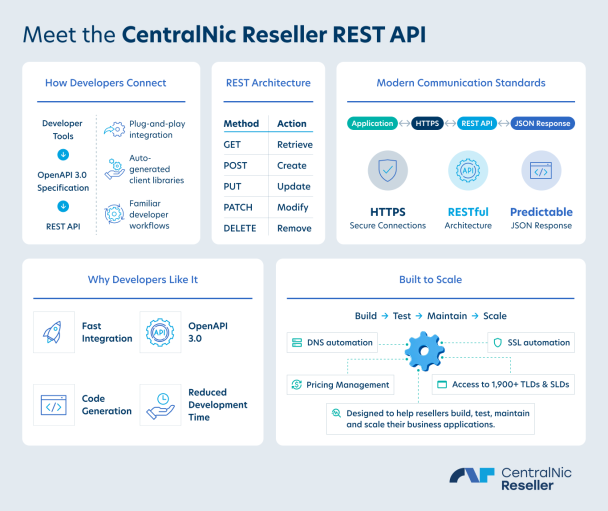
The CentralNic Reseller REST API is exactly what the name promises: a RESTful interface. In other words, one built to specification that uses secure HTTPS requests, that returns predictable JSON responses, and is documented end-to-end with an OpenAPI 3.0 specification. If your team has ever integrated with a modern cloud platform or SaaS product, this will feel immediately familiar. Standard HTTP methods, such as GET, POST, PUT, PATCH, and DELETE, do exactly what you’d expect: retrieve a record, create a resource, update it, and remove it. No surprises or tough learning curves here.

In the same way, because the API is covered by a full OpenAPI 3.0 spec, it plugs directly into the tooling your developers are probably already using. Import it into Postman or Insomnia, two of the larger API platforms, and you have a working collection in minutes. Feed it into an OpenAPI-based code generator and you have a typed client library in your language of choice, no hand-written wrapper required. The everything already exists, so you can get down to work, instead of having to recreate everything.

A New Way to Access a Proven Platform

While this is a change, it’s not an entirely new platform or product. Instead, it’s an upgraded connection to the same reliable features CentralNic Reseller customers already depend on, covering the entire domain lifecycle. The difference is just how you reach it.

Our new REST API is essentially speaking the common internet tongue: sending information through https using JSON files. And as the common language of these sorts of systems, you don’t have to worry too much about how you connect to it. Whether you’re a current user, or one looking to migrate to CentralNic Reseller platform, this API is typical of what to expect from us: infrastructure designed to make resellers’ businesses easier to build, test, maintain and, most importantly, scale. All with access to our industry leading, and ever-growing, selection of more than 1,900 TLDs and SLDs.

Explore the REST API

One API. Complete Domain Lifecycle Management.

Rather than stitching together multiple interfaces for different parts of the platform, the REST API is designed to give you a single, consistent integration point across the CentralNic Reseller ecosystem. That way you’re not learning a new set of capabilities, but reaching familiar ones through a far simpler approach.

Through the API, you can handle core domain lifecycle operations, DNS services, SSL certificate management, domain aftermarket functionality, pricing, billing, and portfolio administration, all through the same authentication model. That consistency is easy to undervalue until you’ve lived without it. When every part of a platform speaks the same structural language, your developers spend their time building features, not context-switching between five different integration patterns for five different modules of the same product.

Specific capabilities available through the API include registrations, renewals, transfers, and other domain lifecycle actions; DNS zone management; SSL certificate ordering, renewal, and lifecycle handling; domain aftermarket operations, including integration with established marketplaces like Sedo for listings and transactions; pricing and billing operations, including transaction history and upcoming renewal visibility; and account and portfolio management tools for teams managing operations at scale.

How the REST API Helps You Automate Domain Operations

This update should make your day-to-day reselling business more efficient. Here are the main reasons why.

Automate High-Volume Workflows

The clearest, most immediate value of our well-designed REST API is automation. Once your systems can talk to CentralNic Reseller using our standard, well-documented interface, you can automate the workflows that used to require a person watching a dashboard and clicking buttons. Registrations, renewals, transfers, and domain updates can be triggered directly from your own applications. DNS management and SSL certificate issuance can be built into provisioning pipelines instead of handled as separate manual steps. Billing, pricing checks, and portfolio management can be pulled directly into your internal tools and customer-facing dashboards. Domain aftermarket activity can be tracked and acted on programmatically rather than monitored by hand.

And this means that handling more domains and customers shouldn’t become an extra burden on your business, just extra revenue.

Reduce Manual Work and Operational Risk

More than just extra effort, every manual step in a workflow is also a place where something can go wrong. Whether a renewal that gets missed because nobody checked the dashboard that week or a billing discrepancy that goes unnoticed until a customer complains, things slip through the cracks. So, when you automate, you don’t just save time, you cut out entire categories of risk that come from people doing repetitive work under time pressure. Because a well-tested automated workflow doesn’t get tired, distracted, or rushed.

Scale Without Increasing Complexity

Which all adds up to the main strategic benefit of automation: what it means for your growth curve. Without it, growth in your domain portfolio or customer base tends to require a roughly proportional growth in operational headcount. More customers, more domains, more manual work, more people needed to do that work. Automation breaks that link.

With workflows built on the REST API, you can support significantly larger portfolios without a corresponding increase in workload and the people needed to do it. Which means that more of your growth can go to the bottom line.

Try the REST API Today

What Are the Benefits of the REST API for Domain Businesses?

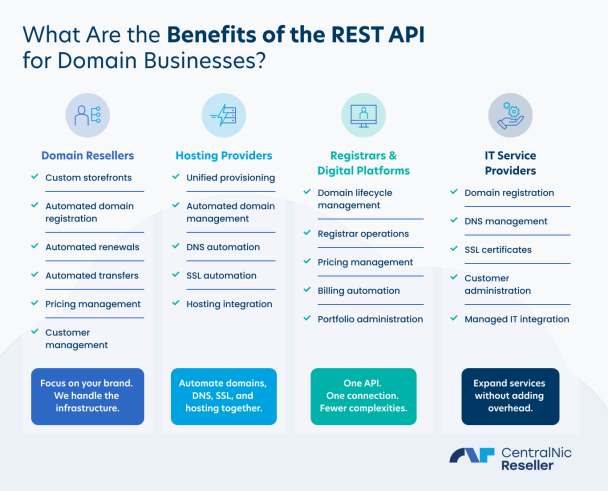
The specifics look a little different depending on where you sit in the domain ecosystem, but the underlying value – faster integration, deeper automation and less manual overhead – holds across every segment we build for.

For Domain Resellers. You can build a custom storefront and automate domain registration, renewals, transfers, pricing, and customer management entirely through your own systems, while CentralNic Reseller operates invisibly behind the scenes. Your customers see your brand and your experience; the REST API handles the infrastructure underneath it.

For Hosting Providers. Domain management, DNS, and SSL certificates can be automated alongside the hosting services you already provide, so customers get a unified provisioning experience instead of separate, disconnected systems for hosting and domains. When a customer spins up a new site, the domain, DNS records, and certificate can all be provisioned in the same automated flow.

For Registrars and Digital Platforms. Direct integration with the CentralNic Reseller platform streamlines domain lifecycle management, registrar operations, pricing, billing, and portfolio administration, giving you a single, consistent connection point instead of a patchwork of legacy interfaces built up over time.

For IT Service Providers. Domain services can be embedded directly into your managed IT offerings, with domain registration, DNS, SSL certificates, and customer administration handled through your own systems and workflows, extending your service catalog without extending your operational overhead.

Why It’s Easy for Developers

Since it was first documented back in 2000, the goal of REST style-APIs was that it would make communication between servers more consistent. Since then, it has become a key part of the internet, and a system devs should be immediately familiar with. Here’s why.

Developer-Friendly from Day One

We built this API with the expectation that a developer should be able to make their first successful call within minutes of reading the documentation, not days. That starts with the architecture itself: REST principles, JSON responses, and standard HTTPS requests mean there’s no proprietary protocol to learn and no unusual data format to parse. If your team has integrated with virtually any modern API in the last several years, the conventions here will be the same.

Faster Development and Testing

Documentation and tooling are where a lot of integration projects lose time, and as such, it’s an area that we’ve invested in. The API is fully described by an OpenAPI 3.0 specification, which means it’s compatible out of the box with Postman, Insomnia, and OpenAPI-based client generators. It has interactive Swagger documentation that lets developers explore every endpoint, see expected request and response formats, and test calls directly from the browser.

And, just as importantly, we have an OT&E (test and evaluation) sandbox environment, available at a dedicated endpoint separate from production. It gives your team a safe, fully functional space to build and validate an integration before anything touches live customer data.

Secure Authentication

Authenticate using either HTTP Basic or JWT bearer authentication, following industry-standard security practices. Every request is scoped to an authenticated account, giving you secure and controlled access to your API resources.

Get Started with the CentralNic Reseller REST API

We are all, in one way or another, in the middle of a broader shift toward automated, API-first operations. Customers expect self-service, internal teams expect systems that don’t require manual babysitting and leadership expects operational costs that don’t have to scale 1:1 with growth. And the CentralNic Reseller REST API is built to support that shift directly.

If your team is ready to see what a modern integration with CentralNic Reseller actually looks like, get in contact, and we can put the documentation and tools in your hands.

Get Started with the REST API

You may also like