What Are the Key Benefits of .DOT Domain for Resellers?
Six reasons this one is worth your time, in rough order of how quickly they pay off.
First-Mover Advantage in an Emerging Category
Launches reward speed. The resellers who enable .DOT before General Availability will get the early searches, the extra press around it, and the impulse registrations that a new extension generates in its first weeks. It’s a one-time thing.
Greater Domain Availability
It’s not fancy, but .DOT gives customers something they often can’t get elsewhere: the exact name they want. Every single-word, category-defining, exact-match name that has been unavailable in .COM since roughly 2003 is sitting there in .DOT. For a customer who has spent three weeks failing to find a decent name, “it’s available” is a pretty great sales pitch.
Portfolio Diversification Opportunities
If most of your revenue comes from three or four legacy extensions, you are at the mercy of decisions you get no vote on. If the registry puts its prices up or a competitor decides to sell .COM at cost to buy market share, then your margin gets thinner and there is very little you can do about it from where you’re sitting.
A wider catalog is the only real defense, and .DOT business domains widen it in a useful direction: a product with its own audience, and nobody currently racing you to the bottom on price.
New Revenue Streams Beyond Traditional Domains
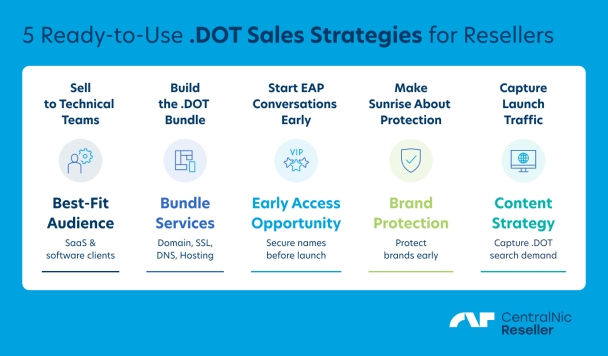
Because .DOT is specifically targeting tech savvy people, you’ve got an audience that already knows the importance of all the extra add-ons, like premium SSL, hosting and more. The .DOT domain will let you increase the average size of each sale by bundling everything needed for a full website together.
Higher Customer Retention and Lifetime Value
The .DOT domain should be a little stickier than some new gTLDs, and the reason is designed into it. Because .DOT is both short and reminiscent of UNIX instructions, developers can version and segment zones with subdomains it without the address getting silly, e.g.: api.example.dot, eu.example.dot, beta.example.dot. It just feels natural to will be a naming convention an engineering team will adopt rather than tolerate.
And even better, a customer running that type of setup in production is not comparison-shopping renewals. The domain is in their DNS records, their certificates, their documentation and their customers’ bookmarks. Technical customers who build infrastructure on a domain are not going to vanish at year-end.
Future Growth Potential
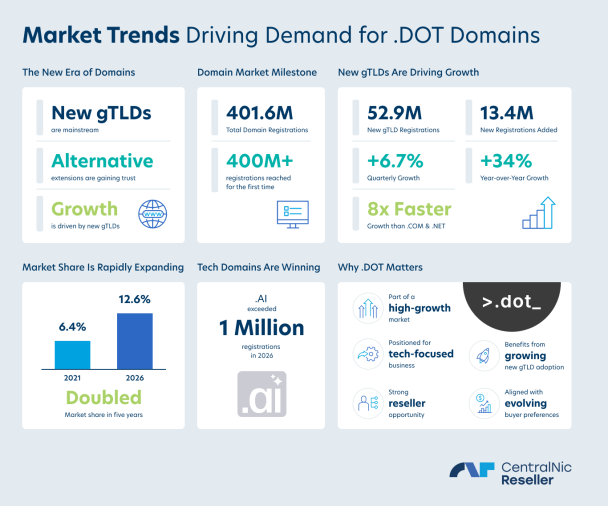
The 2026 ICANN new gTLD application round means more extensions, more choice, and more normalization of non-legacy TLDs. Every new gTLD that lands successfully makes the next one easier to sell. .DOT is launching into a market that is more receptive than the one 2012’s cohort faced. And it’s got space to get attention before the big wave of noise follows it.