Blog

Andrew Moore
Digital Marketing Writer, Domain Industry

How the .FLY TLD Creates New Opportunities for Domain Resellers

You probably don’t think you need to an explainer about what the new .FLY domain is about, or why you would want to add them to your portfolio. Airlines, right? And how many airlines even are there? Both are fair questions and both are fundamentally missing the gigantic point: the USD $11.6 trillion tourism industry that is also served by this new domain. Yes, that’s a big market, but even for one that large, it’s unusually well suited for domain sales. But we’ll get into that later.

As Google Registry has just launched their new gTLD, with the Sunrise period now open (from 1 September – 9 November 2026), and the Early Access Period (10 – 17 November) and General Availability (17 November) soon to follow, if you want to get at the best time to sell a new gTLD, you’d better get knowledgeable fast.

This article collects everything important to know about .FLY domains for resellers to make the best decision about them. From why you should want them, to how best to sell them to your customers.

What is a .FLY Domain?

.FLY is a new generic top-level domain (gTLD) entering General Availability to the public on 17 November 2026, targeting the aviation and tourism industries. And it’s open to everyone, worldwide, through accredited registrars like CentralNic Reseller, without any special local presence requirements, industry restrictions or similar limited eligibility documents.

It’s being run by the Google Registry, who also are the home of a number of new gTLDs, like .APP and .DEV. And this is a good thing. Google, as you’d expect for a technically proficient internet giant, take their domains seriously. Not just with continuous support, but with a security focus that makes their domains more trusted. All Google TLDs are HSTS-preloaded, which prevents browsers from loading a page without HTTPS. And, of course, Google are a smart company. If they’re spending the resources to launch a domain, they see a space for it.

That gigantic space – the tourism and aviation industries – offer an opportunity to those that want to deal in .FLY business domains. At the moment, aviation and tourism are served by the .AERO and .TRAVEL domains, both of which are over 20 years old, and both of which have restrictions on who can register their domains that have limited their uptake. Restrictions that .FLY just doesn’t have. And that gives it much a strong chance to capture the imagination of the industry.

Finally, it has a few of those attributes that everyone loves in their TLDs, and should encourage people to buy .FLY domains: it’s short. Not only that, but it’s a simple verb that opens itself up to be used in all sorts of clever construction. You can even use it for domain hacks, such as POSITIVI.FLY. In other words, this is domain has all the bones it needs to succeed.

View Domain Reseller Program

The last couple of years have shown us that new gTLDs work. They don’t always have the renewal power of some of the older TLDs, but they absolutely dominate the growth numbers. And once they become established, they’ll catch up there too.

But as good as those numbers are, they apply to every new gTLD launch. The question you should be asking yourself, before deciding if you’re going to add the domain to your reseller portfolio, is whether you think there’s a big enough market out there to absorb a new TLD. Because you can position .FLY domains for startups all you want, if the industry underneath it isn’t big enough to support it, it won’t matter. In this case, that’s not a problem, because that industry not only happens to be one of the largest sectors on earth, it’s also one that is far more online than most.

The travel and tourism sector is booming.

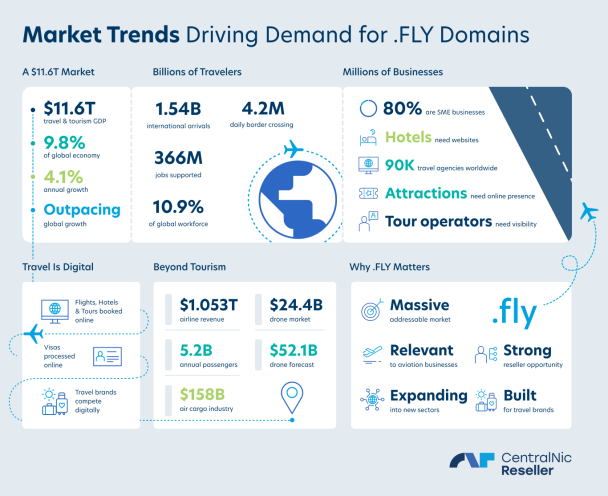
Following the blip of COVID, the sector was bounced back dramatically. And 2025 was its best year on record, with its value of USD $11.6 trillion (with a T) making up a titanic 9.8% of the world’s economy, and growing year-on-year at 4.1%; well above the overall global growth of 2.8%. More than ever before, people are travelling, both for business and pleasure, and paying to do so.

The good thing for resellers is that, unlike so many of the world’s biggest industries, travel and tourism isn’t dominated by two or three mega-corporations. In fact, it tends towards the opposite. Up to 80% of travel tourism businesses are SMEs. Which, if you think about it, makes sense: boutique hotels, tour operators, tourism boards and attractions are all part of this world, and they’re all extremely local. And they all need their own websites to let everyone know they’re there.

On top of that, travel is bought online more than almost anything else. Travel is booked online. Hotels are booked online. Tours, Museums and Visa applicants are all booked online. Travel Agents all need their own spaces – and a domain tied directly to their specialized category, such as beachretreat.fly is a fantastic asset for a business that mostly advertises through Instagram reels.

You’ll notice we haven’t even mentioned pure aviation yet: the obvious market for .FLY extensions. It’s also a trillion dollar industry that is also growing strong. That said, it operates on relatively thin margins and is always looking at new ways – usually digital – to get their audience onto their airplanes.

Finally, don’t let yourself think that .FLY is limited to tourism and airliners. Drones, cargo, eVTOL and logistics are all “fly” business that didn’t exist as a market (or at all) when .AERO launched in 2001. The commercial drone industry is currently USD $24.4 billion, and growing.

Key Statistics Resellers Must Know

If you’re just here for the numbers, here’s the ones that we think matter.

  • Travel and tourism contributed USD $11.6 trillion to global GDP in 2025, or 9.8% of the world economy.
  • The sector supports 366 million jobs, which is 10.9% of the global workforce.
  • There were 1.54 billion international overnight arrivals in 2025, or 4.2 million people crossing a border every day.
  • Up to 80% of travel and tourism businesses are SMEs.
  • There are roughly 90,000 IATA-accredited travel agencies worldwide.
  • Airline revenue is forecast at USD $1.053 trillion in 2026, up 4.5% on 2025.
  • 5.2 billion passengers are expected to fly in 2026, up 4.4%.
  • Airline net profit is forecast at USD $41 billion, on a 3.9% margin.
  • Aviation industry ancillary revenue is worth USD $145 billion and growing at 5.5%, outpacing ticket sales.
  • Air cargo will move 71.6 million metric tons, worth USD $158 billion.
  • Commercial drones were worth USD $24.4 billion in 2025 and are forecast to reach USD $52.1 billion by 2033.

Explore .FLY Opportunites

Why Early .FLY Access Matters for Resellers

The launch window for every new gTLD is prime time for resellers. It’s when consumer and press interest is highest, with the latter feeding the former. It’s when names are most available – especially the high-value, high-margin ones. And it’s when competition for customers who want .FLY domains is at its lowest, because not every reseller is ready to start provisioning the extension day one.

That sounds silly, because enabling a new TLD is such a small job. It’s also a small job that never becomes urgent, so it sits on a list underneath items that demand more attention. And every week it sits there is a week where the customers who wanted a .FLY domain went and bought one from somebody who’d already done the work. Hopefully you.

Because that prime time does not last. And once it’s gone, it’s gone. The good names have been taken, the interest has reduced to a normal simmer. The new gTLD might still be good, but the rush is over.

.FLY has a sharper version of this than most launches, and it’s easy to see why. Aviation and travel names don’t have much of a long tail. There are a countable number of airlines. There are a countable number of major airports. And there is exactly one BOOK.FLY. Thin inventory clears fast, and the contested names in this namespace could be written out on a single sheet of paper. The wider tourism part of the market will carry the domain, but the big spenders will be done quickly.

There’s also the Sunrise fee, or rather the absence of one. Plenty of launches charge an application fee on top of the registration itself, which makes preemptive, defensive registrations harder sells. If you take the fee away, then the conversation changes completely. You’re no longer asking a client to justify a cost. You’re asking them a much simpler question: do you want your brand in this namespace, or would you rather somebody else had it?

What is the .FLY Launch Timeline?

.FLY follows ICANN’s standard launch program, which means four phases and a fairly brisk run from Sunrise to General Availability.

Phase Window What it means for resellers
Sunrise 1 September 2026 (16:00 UTC)
– 9 November 2026 (15:59 UTC)
Trademark-holder window.
High-margin, low-volume defensive registrations
for brands with TMCH-validated marks.
Early Access Period 10 November 2026 (16:00 UTC)
– 17 November 2026 (15:59 UTC)
Domains are available to purchase early
for a premium that decreases
day-by-day until General Availability.
Trademark Claims Starts 10 November 2026 (00:00 UTC)
and run for min. 90 days
Public registrations trigger TMCH
alerts on matching marks.
General Availability Opens 17 November 2026 (16:00 UTC) First-come, first-served at standard wholesale pricing.
Premium tiers released. Can offer bulk to portfolio investors.

Sunrise Period

1 September 2026, 16:00 UTC to 9 November 2026, 15:59:59 UTC. Trademark holders validated through the Trademark Clearinghouse (TMCH) can register exact-match .FLY domains before anything is released to the public. It’s open right now.

Early Access Period

10 November 2026, 16:00 UTC to 17 November 2026, 15:59:59 UTC. Seven days, first-come first-served, with five pricing tiers that start high on day one and step down as the week goes on.

If you haven’t sold through an Early Access Period before, the mechanic is simpler than it looks. Your customer is buying certainty. The earlier they register, the more they pay, and the less chance there is of somebody taking the name first. It’s a straight trade between money and risk, and different customers will sit in different places on that curve.

That said, seven days is not long. So, plan your strategy with your customer now, not as it’s happening.

Trademark Claims Period

From 10 November 2026, running the standard ninety days. Anyone registering a domain matching a TMCH-listed mark gets a warning notice before the registration completes, and the trademark holder is notified afterwards. Note that this runs alongside Early Access and the opening months of General Availability. 

General Availability

From 17 November 2026, 16:00 UTC, ongoing. .FLY opens to everyone, worldwide, through accredited registrars.

Add .FLY to Your Portfolio

What Are the Key Benefits of .FLY Domain for Resellers?

Here are the six main reasons selling .FLY domains will be good for you.

Fights Commoditized Pricing Pressures

Selling legacy extensions is a price war you cannot win. Somebody will always be willing to sell .COM at cost to buy market share, and you get no vote on when they decide to do it. A new domain, like .FLY, offers a product you can sell on merit, as a specific win for a client, not just on being the lowest price at the exact moment a customers googled.

Boosts Low Client Retention Rates

The use case for .FLY domains is pretty straightforward (at least until you get to the domain hacks). And that means that the customers buying it are more likely to have an idea what they’re going to use it for. That should mean that a .FLY domain inside a working travel business is not going to churn the way a parked page will.

Unlocks Forced SSL Cross-Sells

Because .FLY is a Google Registry domain, it is HSTS-preloaded. Which means a .FLY site simply will not load over HTTP. Every website needs SSL. And that means every single .FLY registration is a SSL certificate sale you don’t have to fight for. Attach the certificate at checkout and move on.

Eliminates Niche Eligibility Hassles

Restricted extensions generate support tickets, and support tickets cost you money. The old .AERO domain asks registrants to prove they belong to one of sixteen eligibility categories, using things like an Air Operating Certificate, an IATA code, a pilot’s license or a letter on company headed paper. And while .TRAVEL is lighter these days, registrants still have to attest that they work in the travel industry and keep meeting that definition for as long as they hold the name.

.FLY asks for nothing. It sells through an automated checkout exactly like most other extensions on your list.

Cuts Client Sales Objections Instantly

Selling a new gTLD to an existing client means a pitching about why this domain is worth them spending money on. And that’s much easier with domains with a straightforward use case. You don’t have to spell the name out for anyone with .FLY, they know what it’s for, and know if they can use it. Plus, because it’s a Google Registry domain, they know this one likely has a lot of thought behind it.

Turns Renewals into Predictable Equity

We’ve said it before, and we’ll say it again: while new sales are where you grow, renewals are where the money in the reseller business is. Add to that the truism that the more products a client has with you, the more likely they are to stick around, and you’ve got a winner with .FLY domains. Mandatory SSL combined with businesses that are here for the long haul mean you should be able to turn a significant part of your .FLY domains into long term profits.

Where .FLY Domains Sell Best

Here’s where we come back to that gigantic point from the beginning, the one about this being much bigger than airlines. Aviation is the starting point for .FLY, but it isn’t the whole of it.

Aviation and Airlines: The Primary .FLY Market

This is the obvious market. Airlines, airports, charter operators, maintenance firms, flight schools, ground handling, parts suppliers and aviation recruiters are all sitting on a USD $1.053 trillion industry that moves 5.2 billion people a year.

The opportunity here is that airlines don’t run one website. No, they run loyalty programs and cargo divisions and regional subsidiaries and campaign microsites and status pages. Right now, they are all living as subdomains or slightly awkward .COM registrations, when they could be LOYALTY.FLY.

Oh, and it should go without saying that these big companies will want their defensive BRAND.FLY domains.

Travel Agencies and Tour Operators

This is the big market that you can really reach. Those 90,000 IATA-accredited agencies are real businesses with real websites, and they buy their domains, hosting, email and certificates through resellers rather than direct.

Destination and activity constructions work well here, and there are a lot of destinations.

Drone Technology and Logistics Companies

Commercial drones are a USD $24.4 billion industry heading towards USD $52.1 billion by 2033, and air cargo is moving 71.6 million metric tons a year on top of that.

As we showed above, these are growing markets, but ones that haven’t been served by their own gTLD. Drone and eVTOL companies don’t fit into .AERO, while .TRAVEL is irrelevant to them. The .FLY domain is the only extension that shows what they do and will actually let them register.

Creative Domain Hacks: Thinking Beyond the Industry

As big as they are, you don’t have to limit yourself to aviation and tourism. You can push the domain through its other meanings: that of signifying speed, or stylishness or a launch.

Or you can push its use as another of the classic domain hack TLDs. Where you use the TLD to finish off a word. Whether that’s POSITIVI.FLY or GRUF.FLY, there’s a range of new business names that can be reached.

5 Proven .FLY Reseller Sales Strategies

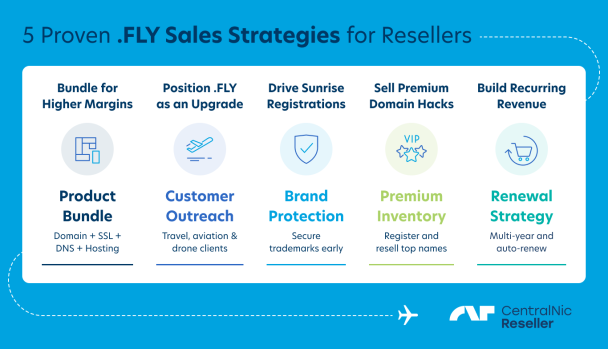
If you’re wondering how to start selling .FLY domains, here are five things you can implement at your Reseller business this quarter without having to build anything new. Some of these are classic reseller tricks, but some apply just to .FLY extensions.

1: Bundle .FLY with Mandatory SSL for Higher Margins

They’re going to need to have SSL if they’ve using a .FLY domain, so better they buy it from you. Prepare the bundle ahead of time, with a slight discount on the individual parts, and consider including other products like DNS and hosting. The more products a customer has with you, the less likely they are to move.

2: Position .FLY as a Brand Upgrade for Aviation Clients

Go through the customers you already have and pull out everyone in aviation, travel, charter, logistics or drones. Send each of them one short email letting them know that the name they couldn’t get anywhere else is available here, or simply that a new, shorter TLD is available, with three examples specific to their business.

3: Create Urgency Around the Sunrise Window

The pitch for corporate clients and anyone holding a trademark is that .FLY is a defensive rather than promotional purchase. They are buying the certainty that nobody else ends up with their brand in a new namespace, which is a much easier thing to get signed off internally. And we’ve got the TMCH capabilities to help you deliver on it.

4: Sell .FLY Domain Hacks as Premium Inventory

If you’ve got an appetite for risk, this is where you could make some high returns. The verb constructions are aftermarket assets, not retail stock. Draw up a shortlist before Early Access opens, decide in advance what each name is worth to you and which day of the price ladder you’re willing to buy on. Then sit on them and see if you can find a buyer.

5: Build a Recurring Revenue Engine with Renewals

One way to encourage recurring renewals is to offer multi-year registrations at a bundled rate. But don’t just stop after the initial sale, make sure your renewal flow works hard to make it easy for customers to stay your customers. Use auto-renews, personalization and other classic tactics to keep them onboard.

Begin Selling .FLY Domains: Your Implementation Roadmap

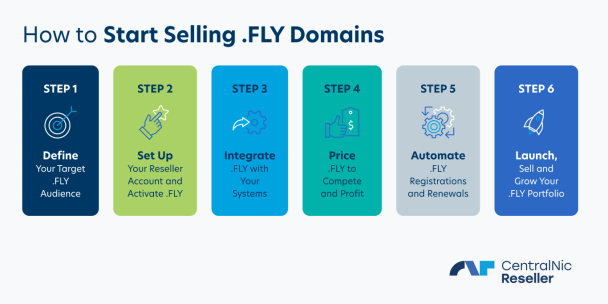
Once you’ve decided to add .FLY to your reseller inventory, you have to work out how to put that decision into practice. To help you, here’s a the simple, six-step program to selling .FLY domains.

Step 1: Define Your Target .FLY Audience

Start with the customers you already have rather than the ones you’d like, before expanding to the ones you think you can service. Be clear, because different segments want different things, and you might be better positioned to sell to ones that fit your larger business.

Step 2: Set Up Your Reseller Account and Activate .FLY

Create a CentralNic Reseller account, confirm your details, and then switch .FLY on in your catalogue. While you’re in there, switch on .EAT and .HERE too. They’re launching from the same registry on exactly the same schedule, which means the same integration work gets you three products instead of one.

Step 3: Integrate .FLY with Your Systems

Choose the right way to integrate your systems with ours. We have seven API gateways, being EPP, HTTPS, SMTP, XRRP and SOAP/XML-RPC, plus a modern REST API. There are modules for WHMCS and Blesta, and a white-label Control Panel if you’d prefer that. Whichever route you take, test your launch-phase logic in the OT&E environment before Sunrise closes, as you want to be ready for Early Access.

Step 4: Price .FLY to Compete and Profit

Our wholesale pricing is published in full, across the CNR+ tiers, so you can model your margins properly before committing to a retail figure. Remember you’re not just competing against other .FLY providers, but other TLDs entirely.

Step 5: Automate .FLY Registrations and Renewals

Bulk .FLY for resellers only works if registration, renewal and transfer all happen without anybody touching them. Otherwise, the admin involved in moving that many domains eats into whatever margin the product was going to make you. Automate it all through the API and spend the time you get back on selling instead.

Step 6: Launch, Sell and Grow Your .FLY Portfolio

Once everything is done, make an announcement post, publish your .FLY content and get ready to sell to customers. Remember to check in and see if what you’re doing is working, and change it if it isn’t.

Start Selling .FLY

CentralNic Reseller: Your Launchpad for .FLY Success

Whether you’re an established company looking to add domains to your main business offering, or dedicated domain reseller, CentralNic Reseller is a great platform to do it on. We have been helping domain resellers thrive for over two decades now, and there are many reasons for our longevity and success.

Wholesale Pricing and Automated Systems

We offer over 1,900 TLDs and SLDs at wholesale prices, with regular promotions that let you run acquisition campaigns without eating into your own margin. Registration, renewal and transfer are fully automated in real time. Our pricing is published in full, so if you’re working out where to buy .FLY TLD for resellers at the best price, you can do the math before you commit to anything.

API-First Infrastructure

We have seven API gateways, including EPP, HTTPS, SMTP, XRRP and SOAP/XML-RPC, plus our REST API. They come with full documentation, bulk tools and an OT&E environment so you can test everything before it goes live. Our customers talk about our API more than anything else, which we’ve decided to take as a compliment.

Advanced Modules for WHMCS

Our WHMCS integration covers the full catalogue and runs registrations, transfers, renewals and deletions straight through the CNR API. It comes with addons for domain search, import, migration, monitoring, DNS and SSL. If you’re running Blesta instead, we have modules for that as well.

Full White Label Control Panel

Our white-label Control Panel gives your customers a branded interface where they manage their own domains, SSL and DNS without ever seeing our name. It includes a multi-level sub-reseller system, so you can build a hierarchy of accounts underneath you with their own pricing and settings.

Proven Expertise

We’ve been doing this since 1999, we’re an ICANN-accredited registrar, and we’ve supported new gTLD launches ever since there were new gTLDs to support. TMCH services are included, which is what makes the Sunrise conversation in Strategy #3 possible without you building anything.

Get Started with .FLY Domains

If you’re ready to get your part of that gigantic aviation and tourism industry with .FLY domains, the time is now. Sunrise closes on 9 November, with Early Access running for one week, before General Availability opens. This launch period is the best time to sell new gTLDs, and it won’t wait for you. It happens once and then is over.

But just being there isn’t enough, you need the right technical support to offer a customer experience that will earn you the renewals that will make your business successful. And that’s where we come in; here to help you through this launch, and every other part of being a thriving domain reseller.

Become a CentralNic Reseller and get access to .FLY alongside 1,900+ other extensions at wholesale prices.

Let’s Work Together

FAQ

Why should domain resellers add .FLY to their TLD portfolio?

Because it’s sitting on top of a USD $1.05 trillion aviation industry, and a USD $11.6 trillion travel sector, while having a name that is an easy sell to customers. And it has mandatory SSL with every registration, so the bundling sells itself.

When does the .FLY Sunrise period start and end?

Sunrise runs from 1 September 2026, 16:00 UTC to 9 November 2026,15:59:59 UTC. Early Access follows from 10 to 17 November, and General Availability opens on 17 November at 16:00 UTC.

Why should resellers prioritize .FLY TLD during the Sunrise period?

It’s high-margin product with a hard deadline, and there are a limited number of aviation companies to sell to. If you can get them, they are yours for the long haul. Airports don’t just go away.

How does .FLY compare to .AERO and .TRAVEL?

The difference is mostly around registration eligibility. The new .FLY domains have no restrictions. On the other hand, .AERO is very limited to aerospace companies, and while .TRAVEL has cut down on the amount of information it requires about registrants involvement in the tourism industry, it’s still not zero.

Who can benefit from reselling .FLY domains?

Anyone with aviation, travel, tourism, charter, logistics or drone customers on their books. Agencies and hosts serving small businesses will find plenty of fit, given how much of the travel sector is made up of SMEs (small and medium enterprises). And domain investors will be interested in the domain hacking opportunities.

How can I become a .FLY domain reseller?

Create a CentralNic Reseller account, integrate your systems to ours through one of our API gateways, activate .FLY in your catalogue, set your retail pricing, and start selling.

You may also like