
Every website you’ve ever visited has 1 thing in common: they all have a domain. And domains don’t come from nowhere. That website’s owner had to buy it, and someone had to sell it. That someone could be you. Domain reselling is one of the simplest ways to be part of digital services economy, with low overheads, recurring revenue, and the ability to scale. So, whether you’re a hosting provider looking to round out your product offering, a web agency wanting to keep clients in-house, or an entrepreneur looking for new ways to earn money, this guide covers everything you need to know.
Blog
Andrew Moore
Digital Marketing Writer, Domain Industry
Digital Marketing Writer, Domain Industry
How to Become a Domain Reseller: The Complete Guide
What Is a Domain Reseller?
A domain reseller purchases domains at wholesale prices from an ICANN-accredited registrar and sells them to end customers under their own brand. Think of it as a supply chain: registries maintain the master databases for each top-level domain, registrars connect directly to those registries, and resellers act as the customer-facing retail layer.
Resellers don’t need ICANN accreditation, which requires significant financial, technical and compliance commitments. Your registrar partner handles the backend. You focus on selling, branding, and serving your customers.
It’s worth distinguishing domain reselling from domain investing. Investors buy individual domain names speculatively, hoping to flip them at a profit. Resellers operate an ongoing business, facilitating registrations, renewals, and transfers on a continuous basis.
Domain reselling is particularly well-suited to businesses that already serve clients with digital needs. If your customers already need a domain to use your product or service, reselling lets you capture that revenue instead of sending it elsewhere.
Why Domain Reselling Is a Powerful Recurring Revenue Model
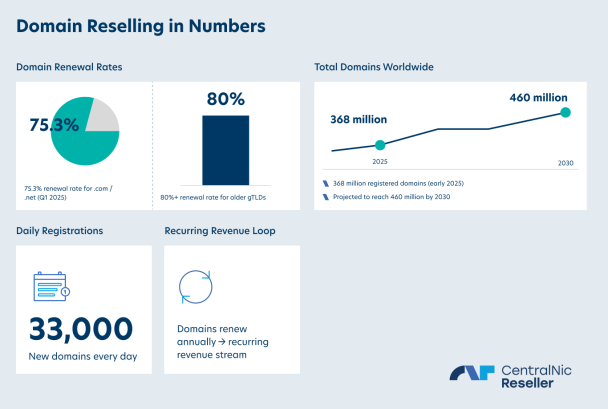
Domain names aren’t a one-time sale. They renew every year, and most customers keep renewing. According to the Domain Name Industry Brief (DNIB), the combined renewal rate for .com and .net domains sits at 75.3% as of Q1 2025, some older gTLDs, like .org getting numbers above 80%. That percentage represents the number of domains you sell this year that earn you money next year. And the year after.
The market behind those renewals is substantial. There are over 368 million registered domain names worldwide as of early 2025, with around 33,000 new registrations happening every day. Industry projections put total registrations at nearly 460 million by 2030. The demand for domains isn’t slowing down. And in a way it can’t. Even as the internet changes, websites and apps still need addresses.
The cost structure makes it especially attractive. There’s no physical inventory, no warehousing, and no shipping. Your registrar partner handles the technical infrastructure, registry connections, and compliance. Your overheads are your platform, your marketing, and your time.
Domains are also one of the stickiest products in the digital services stack. Once a customer registers a domain through your platform, moving it requires a transfer process most people would rather avoid. That keeps churn low and creates a stable revenue base. Better still, domains act as a gateway product. Every customer who registers a domain is a candidate for SSL certificates, DNS services, domain blocking solutions, web hosting, and email, each adding margin on top of the initial registration.
How Domain Resellers Actually Make Money
Understanding the economics of domain reselling is key to building a profitable operation. There are several revenue streams available, and the most successful resellers layer them together.
Registration margins are the foundation. You purchase domain registrations at wholesale prices from your registrar and sell them at retail. The difference is your margin. For example, if your wholesale cost on a .com is around $9 and you sell it at $15, that’s $6 per registration. Individually modest, but at volume it adds up quickly.
Renewal margins are where the real value lies. Every domain your customers renew generates the same margin again, year after year, with virtually zero acquisition cost. If you’re retaining 75% of your customers annually (like we mentioned above), your recurring revenue base compounds over time even before you factor in new sales.
Transfers and restores also contribute. When customers transfer existing domains to your platform, or when expired domains need to be restored, these transactions generate fees. They’re not typically the core of a reseller’s revenue, but every inbound transfer becomes a future renewal.
Cross-selling and upselling is where per-customer revenue really expands. Every domain registration opens the door to DNS management, WHOIS privacy, SSL certificates, GlobalBlock and other domain blocking solutions, email hosting, and web hosting. These products often carry higher margins than the domain itself and bundling them increases customer stickiness.
Portfolio scaling ties it all together. If you build a portfolio of 1,000 domains at an average margin of $6 per domain, that’s $6,000 in annual recurring revenue. At a 75% renewal rate, 750 of those renew the following year automatically, while every new registration stacks on top. By year three, the compounding effect becomes significant even with conservative growth assumptions.
Domain reselling isn’t about chasing big margins on individual sales. It’s about building a portfolio that grows and compounds over time, then expanding revenue per customer through complementary products.
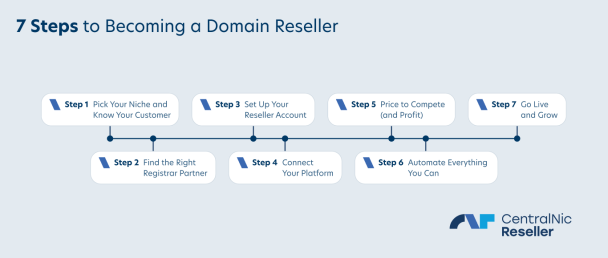
7 Steps to Becoming a Domain Reseller
One of the best things about launching a domain reselling business is how quickly and easily you can get up and running. To help you get started, here’s our 7-step plan.
1. Pick Your Niche and Know Your Customer
Before you register a single domain, get clear on who you’re selling to and why. A web hosting provider adding domains to their product offerings needs a very different strategy to a freelance web designer managing a handful of their clients’ sites.
Common types of domain resellers include hosting companies looking to offer a complete package, digital agencies managing domains on behalf of clients, IT service providers handling infrastructure for SMBs, and entrepreneurs building a standalone domain retail business. What you do should determine your TLD selection, your pricing, your integration approach, and how you market your services.
2. Find the Right Registrar Partner
Your registrar is the backbone of your reselling operation, so this choice matters. Look for wholesale pricing that gives you room to build healthy margins, a wide selection of TLDs, robust API access for automation and integration, white-label capabilities so customers see your brand, and reliable technical support from people who understand the domain industry.
We cover how to choose a platform in more detail later in this guide, but the short version is: don’t just compare headline prices. Renewal costs, integration options, documentation and support all matter a lot if you want your domain reselling business to go the distance.
3. Set Up Your Reseller Account
Most reseller programs have a straightforward sign-up process with no ICANN accreditation required. Normally, you’ll have to provide your business details, agree to the reseller terms, and fund your account with an initial prepaid balance to cover your first domain transactions. From there, you’ll have access to the platform’s tools which allow you to integrate into your business.
4. Connect Your Platform
How you sell depends on your technical setup and your customers’ expectations. There are several routes:
API integration gives you full control. You connect directly to your registrar’s API and build directly into your own platform. This is the most flexible option for resellers who want a fully custom experience that saves time and effort.
Billing platforms like WHMCS or Blesta are popular with hosting providers. Their plug-and-play registrar modules connect to supported domain registrars, enabling domain registration, renewals, billing, and customer management in one place, significantly reducing development time.
A white-label control panel is the fastest route to market for resellers who don’t want to build custom integrations.
5. Price to Compete (and Profit)
Pricing strategy is a balancing act. Set prices too high and you lose to competitors; set them too low and you erode your margins.
A common approach is to use competitive registration pricing to attract new customers, then build your real margin into renewals, where customers are far less price-sensitive. Take advantage of promotional pricing from your registrar on specific TLDs to run limited-time offers that drive acquisition without permanently undercutting your margins.
If you’re bundling domains with DNS, SSL, hosting, or email, you have more flexibility on domain pricing because the overall customer value is higher.
6. Automate Everything You Can
The resellers who scale successfully are the ones who remove as much manual work from their process as possible. That means automating registrations, so customers get instant confirmations, setting up renewal systems with automated notifications and auto-renew to minimize involuntary churn, enabling self-service DNS management, and streamlining domain transfers so inbound migrations are as frictionless as possible.
The more you automate, the more your revenue grows without your workload growing alongside it.
7. Go Live and Grow
If you’ve followed the other steps, it’s time to start selling.
Focus your early efforts on your existing customer base. If you already offer hosting, web design, or IT services, domains are a natural addition for current clients. From there, build out your acquisition strategy through content marketing, SEO, and partnerships.
Remember to track your key metrics from day one. Those are registration volumes, renewal rates, average revenue per customer, and cross-sell conversion. How you do across them will tell you where to invest and what to change.
Technical Steps to Become a Domain Reseller (after you signed up)
The 7 steps above cover the business side of becoming a domain reseller. This section gets into the technical detail of actually connecting your platform to your registrar’s systems.
1. Get API credentials and access the test environment
Before you make any live API calls, you need authenticated access to your registrar’s system. That means API credentials, IP whitelisting to secure your connection, and access to an OT&E (Operational Test and Evaluation) environment where you can test your integration safely. CentralNic Reseller provides a dedicated OT&E sandbox, so you can make sure everything works correctly before touching real domains.
2. Implement domain search and availability checks
Your customers need to search for domains and see what’s available in real time. This means integrating availability checks through the API, pulling TLD data, and returning results fast enough to keep the experience smooth. CentralNic Reseller supports 1,900+ TLDs and SLDs with real-time domain search across multiple API gateways, so you can offer a wide catalogue without building separate connections for each registry.
3. Build domain registration workflows
Once a customer finds their domain, the registration needs to happen reliably and quickly. CentralNic Reseller automates registrations using standardized protocols (EPP, XML, SOAP, HTTPS) which means fast provisioning and compliance with registry rules. You deal with the customer-facing flow, while the heavy lifting on the registry side is handled for you.
4. Integrate DNS and zone management
A domain isn’t much use if DNS isn’t configured properly. Integrating DNS management into your platform means customers can start using their domains straight away, without manual setup or configuration errors. CentralNic Reseller’s DNS endpoints include Anycast DNS hosting and full record management, giving you the tools to automate zone creation and deliver a production-ready experience from the moment a domain is registered.
5. Automate renewals, transfers, and lifecycle processes
Domains move through several critical states: active, expiring, expired, redemption, and transfer. Each of these transitions needs to be handled correctly, or you risk losing a customer’s domain. Automating it all keeps everything running smoothly and prevents the kind of accidental lapses that damage trust and cost money. Build these lifecycle processes into your platform early; they’re not optional extras.
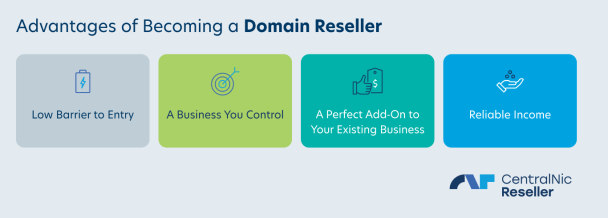
What Are the Advantages of Becoming a Domain Reseller?
Why would you want to get started with domain reselling, whether as a standalone business or a fresh offering from your current one? Here are the key reasons it’s a great idea.
Low Barrier to Entry
The main advantage of becoming a domain reseller is that the barrier to entry is low. You don’t need ICANN accreditation, technical infrastructure, or significant upfront capital. You just need to sign up for a reseller account and fund your balance, and you can be reselling domains in no time at all. Few business models offer this kind of speed to market.
A Business You Control
You own the customer relationship. With white-label tools, your customers interact with your brand throughout the entire experience, from domain search to registration to renewal. They never see your registrar partner behind the scenes. That brand ownership builds equity in your business, not someone else’s.
What’s more, reselling is also inherently flexible. You choose which TLDs to offer, how to price them, and how deeply to integrate. A freelancer managing 50 client domains and a hosting company processing thousands of registrations per month can both operate profitably. And you can grow from the former into the latter.
The Perfect Addon to Your Existing Business
One of the best reasons to look into Domain reselling is that it easily fits around what you already do. It works as a standalone operation, but it’s especially powerful when it’s offered alongside existing services. If you’re a hosting provider, adding domains means your customers don’t need to go elsewhere for a core part of their setup. If you’re a web agency, managing domains on behalf of clients keeps the entire project under your roof. In short, it can easily become part of an existing business.
Reliable Income
The most important benefit of starting a domain reselling business is that your revenue is both predictable and compounds over time. Beyond the financial mechanics covered earlier, this is an important advantage for you: predictable recurring revenue makes it easier to plan for your business. And that makes it easier to find investment in your business, if you ever find yourself in the position where you need more capital or if you decide it’s time to sell up. A growing domain portfolio with strong renewal rates is a measurable asset on your books.
The Hidden Challenges of Starting a Domain Reseller Business
Domain reselling may have a low barrier to entry, but that doesn’t mean it’s without risk. Here are the challenges that can catch new resellers off guard.
Thin margins and pricing traps. Margins on popular TLDs like .com are tight, and new resellers often make it even tighter to compete. But promotional wholesale rates on new registrations usually don’t carry through to renewals. If your retail price is based purely on that promotional cost that later increases, every renewal can actually lose you money. Registries can also raise their wholesale prices, sometimes significantly. The solution is to diversify your TLD offering, build your real margins into renewals and add-on products, and always model your pricing against renewal costs, not just promotional rates.
Customer support complexity. Domain issues get technical quickly. Whether from DNS misconfigurations through to transfer disputes, WHOIS complications, and registry-specific requirements, they all can generate support tickets that take real expertise to resolve. Choose a registrar with strong documentation and responsive support, while trying to build your own customer facing knowledge and support automation.
Keeping up with policy and compliance. There are many layers of polices, rules and compliance affecting domains, starting at the top with ICANN and cascading down through regions and countries, with GDPR and directives like NIS2. Not only are there a lot of them, but they’re not set in stone either. And they affect every domain you sell, so you need to know what’s going on. Working with a registrar that has deep experience in the ICANN ecosystem and proactively communicates policy changes makes this far more manageable.
Security risks. Compromised API credentials or platform vulnerabilities can lead to domain hijacking, unauthorized transfers, or malicious DNS changes. For a small reseller, losing control of customer domains is potentially unrecoverable. Treat API security as a priority from day one. You should use IP whitelisting, two-factor authentication, and restrict access credentials to the minimum number of people necessary.
Customer acquisition in a crowded market. Retail giants like GoDaddy and Namecheap have massive brand recognition and marketing budgets. Competing head-on as a general-purpose reseller is a losing game. Instead, win by focusing on your niche. If you’re a hosting provider, bundle domains seamlessly into your existing offering. If you’re an agency, position domain management as part of your full-service proposition. Compete on your terms, not theirs.
What to Look for in a Domain Reseller Platform
Not all reseller platforms are built the same. Here are some things you can help you decide if a reseller platform is right for you.
Pricing transparency. You need to see your wholesale costs clearly, including renewal prices, not just first-year registration rates. Watch out for hidden fees, inflated renewals, or pricing structures that change without notice.
TLD range. The more extensions you can offer, the more customers you can serve. A platform with a limited TLD catalogue will cap your growth as your customer base diversifies.
Integration options. Whether you need a direct API connection, a billing platform module, or a ready-made control panel, your registrar should support the way you want to work.
White-label capabilities. Your customers should see your brand at every touchpoint. If the platform doesn’t let you fully white-label the registration, management, and renewal experience, you’re building someone else’s brand equity.
Automation and lifecycle management. Renewals, expiry notifications, DNS provisioning, and transfers should all be automatable. If you’re handling any of these manually, something is wrong. And it’ll get more wrong as your business grows.
Support quality. When a domain issue escalates, you need access to people who understand the domain industry, not a generic helpdesk.
Scalability. The platform that works for your first 100 domains needs to work just as well at 10,000. Make sure their infrastructure, pricing tiers, and tools can grow with you.
CentralNic Reseller Helps You Launch Your Domain Reseller Business
Choosing the right platform is the single most important decision you’ll make as a domain reseller. CentralNic Reseller is built specifically for resellers and registrars, with over 25 years of experience powering domain businesses worldwide.
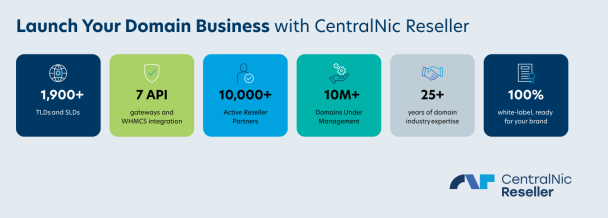
Built on enterprise-grade registry infrastructure. CentralNic Reseller connects directly to registries across an industry leading 1,900+ TLD and SLD extensions, giving you access to an enormous domain catalogue through a single platform.
Wholesale pricing that protects your margins. Transparent, competitive wholesale rates on registrations and renewals, with regular promotions and offers across popular TLDs. No hidden fees, no surprise renewal markups.
API-first architecture for automation and scale. CentralNic Reseller’s API is designed for resellers who want full control. With 7 gateway options, comprehensive documentation, and a dedicated test environment, you can integrate domain registration, management, and renewal directly into your own platform. Prefer a plug-and-play approach? CentralNic Reseller modules for platforms like WHMCS and Blesta are also available free of charge.
White-label domain reselling. Every customer touchpoint can carry your brand. CentralNic Reseller’s white-label control panel lets you manage your entire domain business under your own identity.
Reliable support from domain industry experts. Dedicated account managers and a technical support team with deep domain industry knowledge, not a generic ticket queue.
Designed for growth. Whether you’re managing a hundred domains or tens of thousands, the platform scales with you, offering you better prices as you grow. All on the same infrastructure, same API, and same support.
The Time to Enter the Domain Reseller Market Is Now
The domain market is growing. Every new business, every rebrand, every side project starts with a domain name. That demand isn’t going away.
Domain reselling gives you a way to capture a share of that market with minimal upfront investment, predictable recurring revenue, and strong cross-sell potential. The model works whether you’re adding domains to an existing hosting or agency business, or building a standalone operation from the ground up.
Choosing the right registrar partner can give you the pricing, tooling, automation, and support to grow efficiently. The wrong one can lead you to stall as it creates friction at every step.
CentralNic Reseller is built for exactly this. Create your free reseller account and start building your domain business today.
Frequently Asked Questions
Who can become a domain name reseller?
Anyone. You don’t need technical expertise, ICANN accreditation, or a large starting budget. Domain reselling is particularly well-suited to web hosting providers, digital agencies, IT service providers, and digital entrepreneurs.
How much does it cost to become a domain reseller?
Startup costs are minimal. Most reseller programs are free to join, with your only upfront cost being a prepaid account balance to fund your first domain transactions. There are no monthly platform fees with CentralNic Reseller, so you only pay for what you sell.
Do I need ICANN accreditation to resell domains?
No. Your registrar partner holds the ICANN accreditation and handles all registry connections, compliance, and policy obligations on your behalf. As a reseller, you operate under their accreditation.
Is domain reselling profitable in 2026?
Yes. With over 368 million domains registered worldwide, a market projected to reach $10.49 billion in 2026, and renewal rates above 75% for established TLDs, the fundamentals are strong. Profitability depends on your pricing strategy, TLD mix, and ability to cross-sell complementary products like SSL and hosting.
How do domain resellers make money?
Through a combination of registration margins, renewal margins, transfer and restore fees, and cross-selling products like SSL certificates, DNS management, domain blocking solutions, email, and web hosting. The recurring nature of domain renewals means revenue compounds as your portfolio grows.
Can I set my own prices?
Yes. You purchase domains at wholesale rates from your registrar and set your own retail prices. Your margin is the difference. You have full control over your pricing strategy, including promotional offers, bundled pricing, and tiered pricing for different customer segments.
How do I integrate domain registration into my hosting business?
The most common route is through a domain registrar module within platforms like WHMCS or Blesta, which integrates with supported registrars to handle domain registration, renewals, and billing alongside your hosting products. For more control, you can integrate directly via API.
Can I sell domains under my own brand?
Yes. This is known as white-label reselling. With the right platform, your customers see your brand throughout the entire experience. CentralNic Reseller offers a fully white-label control panel and brandable customer-facing tools.
What is the minimum investment required to start?
There is no fixed minimum beyond the prepaid balance needed to fund your first registrations. With domain wholesale costs starting at just a few dollars per registration, you can begin with a very modest investment and scale as revenue grows.
Can I offer SSL certificates as a domain reseller?
Yes. SSL certificates are one of the most natural cross-sell products for domain resellers, and CentralNic Reseller offers a range of SSL certificates that you can resell alongside domains. Bundling domains with SSL increases your per-customer revenue and adds value for your customers.
You may also like
How CentralNic Reseller ACME Simplifies SSL Certificate Management Automation
October 8, 2026 | By Andrew Moore | 10 Min ReadAutomated SSL certificate management arrives on 5 October 2026.
Read more

How the .FLY TLD Creates New Opportunities for Domain Resellers
October 7, 2026 | By Andrew Moore | 21 Min ReadYou probably don’t think you need to an explainer about what the new .FLY domain is about, or why you would want to add them to your portfolio.
Read more
Why .DOT Domains Are the Next Big Opportunity for Domain Resellers
September 23, 2026 | By Andrew Moore | 17 Min ReadLet’s get the obvious out of the way first.
Read more