Blog

Andrew Moore
Digital Marketing Writer, Domain Industry

Why .EU TLD Is a Core Domain Extension for Every Reseller Portfolio

April 2026 was a big month for one part of the digital landscape, as .EU celebrated its twentieth anniversary. Twenty years has seen it establish itself as a serious, steady and secure part of the online world, serving as a European domain extension to represent the 27 nations that make up the 3rd largest economic bloc in the world. And an invaluable part of every reseller’s domain portfolio.

In this article, we’re going to cover everything important about .EU domain extensions for resellers to know; who it’s targeted at, and why you should be looking to stock them.

What is a .EU Domain Name?

A .EU domain is the country-code top-level domain (ccTLD) for the European Union. Except it isn’t really a country. Most ccTLDs are made for a single nation: .DE for Germany, .FR for France, or .IT for Italy. By contrast, the .EU TLD covers to the whole bloc of 27 countries, plus Iceland, Liechtenstein and Norway. One extension for a whole continent’s worth of markets.

It’s run by EURid, the registry appointed by the European Commission to manage .EU and its Cyrillic and Greek-script siblings, .ею and .ευ. Unlike the generic TLDs governed under ICANN, .EU answers to a European mandate, which is part of what gives it its regional character: that of a trusted, technologically considered domain. Since launching in 2006, it has grown into one of the largest ccTLDs in the world, with more than 3.8 million registrations on the books as of the start of 2026.

Eligibility is the one rule worth knowing up front. You can register an .EU domain if you’re a citizen of an EU member state (or Iceland, Liechtenstein, or Norway) no matter where in the world you actually live, or if you’re a resident, business, or organisation established in one of those countries. So an EU citizen running a startup out of São Paulo qualifies. A non-EU national qualifies the moment they have a registered business in the bloc. It’s a gate, but a generous one, and for resellers it’s a useful filter rather than a barrier. More on that later.

The Untapped Potential of .EU TLD for Resellers

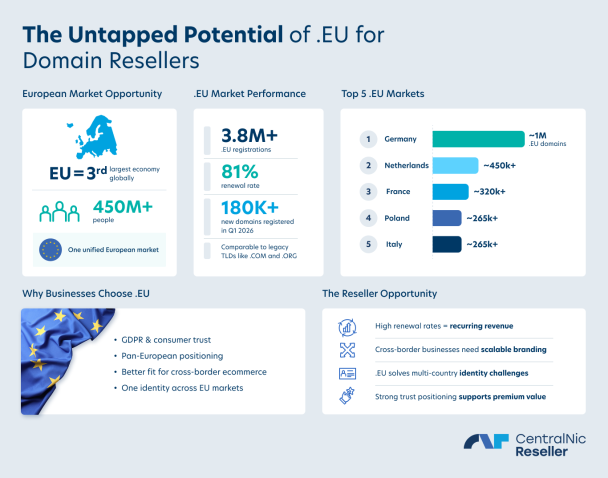
The European Union is the 3rd largest economy on the planet, behind the US and China. Around 450 million people, in a single market built specifically to let goods, services and businesses move across borders, and a digital economy that the EU has spent the better part of a decade actively trying to grow through SME digitalisation programmes. When a small manufacturer in Portugal wants to sell to customers in Germany, the whole apparatus of the single European market is designed to make doing business together easy. Their domain is designed to do the same thing too.

The demand for .EU is solid. Total registrations sit above 3.8 million, with a little more than 180k new domains registered during the first quarter of 2026. Germany leads the pack with nearly a million .EU domains on its own, followed by the Netherlands, France, Poland and Italy. What’s more, .EU renewal rate consistently sits around 81%. In other words: people who buy these domains keep them. That’s about the same renewal rate that the old guard like .COM and .ORG achieve.

So why .EU specifically, and not just a local ccTLD? A few reasons, and they stack.

There’s the badge of trust. An .EU domain shows that the business behind it operates within the European Union’s regulatory framework, which after years of GDPR headlines now functions as shorthand for “this company takes data and consumer protection seriously.” And it’s a continuous process, with EURid always staying at the forefront of domain security. For a European customer deciding whether to hand over a credit card number, that means something. Eurid themselves have also done a lot of work to keep .EU domains secure.

Then there’s the fact that local businesses increasingly want .EU, not just .DE, .FR, or .IT. A national domain says you’re a German company, or a French one. Useful, until the moment you want to sell across the border, at which point a .DE can read as parochial to a buyer in Spain. The .EU domain says you’re European. For businesses whose ambitions extend past their national borders, that’s a big win.

This matters most for cross-border e-commerce, which is exactly the activity the single market exists to encourage. A retailer shipping to twelve countries doesn’t want to explain, on every checkout page, why their domain ends in the code of a country the customer doesn’t live in. The .EU extension shows this in a simple manner, while also conveying that you’re a business that expects to deliver to those other countries. Not just down the street.

That’s really the heart of it. The .EU TLD gives a business a pan-European identity. One domain that works in Tallinn and Lisbon and Dublin without modification, without a fleet of country-specific sites, without picking which nation gets to be the “real” headquarters in the URL. For companies that genuinely operate across EU markets, there is no other extension that does this job.

Get Started with .EU Today

What Makes .EU a “Core” Domain Extension

Plenty of TLDs are nice to have as part of a reseller’s primary domain offerings. But a core extension is one you’d feel the absence of, and for any reseller serving European clients, .EU is in that category. Three things put it in that category, and all three feed directly into portfolio economics.

The first is regulatory backing. The .EU TLD exists because the European Commission created it and EURid manages it under that mandate. It’s here to foster growth across the entire bloc, and is fundamentally different from a generic extension launched by a private company chasing a profit. The registry’s eligibility checks, dispute resolution procedures, and alignment with EU law mean the trust isn’t just marketing. It’s structural. When you sell an .EU domain, you’re selling a slice of that reliable credibility, and credibility is the thing your clients can’t easily manufacture on their own.

The second is renewal behaviour, which is where resellers actually make their living. A domain that sells once and lapses is a constant treadmill of securing and losing customers. A domain that renews year after year is something you can bank on. With .EU renewal rates sitting around 81%, it’s a steady, dependable line in a portfolio. Stable renewals also make revenue forecasting less of a guessing game, and helps resellers make better long-term business decisions.

The third is the local SEO angle: the .EU versus .COM question every European client eventually asks when looking at ccTLD. The answer is the same, though with a tiny bit of spice. A .COM is global, generic, and gives a search engine no geographic signal at all, while a .EU plants a flag. For a business targeting European customers, that regional relevance can help with local search visibility in a way a generic extension simply doesn’t, but it does so without locking the brand into a single country the way a national ccTLD would. It’s the middle path: more rooted than .COM, less narrow than .DE. For a lot of European businesses, that’s precisely the right altitude.

5 Revenue-Driven Reasons to Add .EU TLD to Your Reseller Portfolio

Trading Bloc Strategy is fine, but resellers run businesses, and businesses run on margins. Here are five concrete reasons the .EU TLD deserves its place.

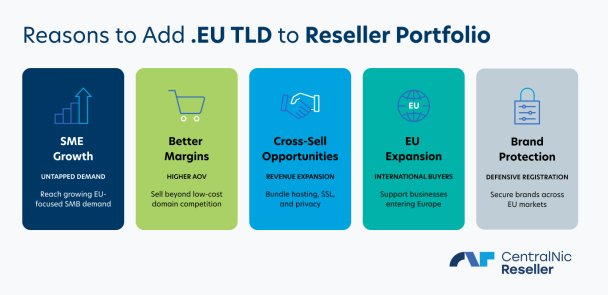
1. Untapped Demand Among SMBs Entering the EU Market

Small and medium businesses are digitising at pace, and a meaningful slice of them are doing it specifically to reach European customers. Every one of those businesses needs an address. The reseller who offers .EU as a natural option, rather than defaulting to .COM and hoping, captures demand that’s already there. You’re not creating the appetite. You’re just being the one who answers it.

2. Higher Average Order Value (AOV) Compared to Generic TLDs

Generic TLDs are a race to the bottom on price, and everyone selling them knows it. The .EU TLD tends to command a healthier price point because it carries genuine value: eligibility, trust, and regional relevance. Clients who want a .EU have already moved beyond just thinking about price. That lifts your average order value and protects your margin from the relentless downward pressure of the bargain bin.

3. Cross-Sell Opportunities – Hosting, SSL, Privacy Protection

A domain is rarely the end of the customer relationship. It’s the start of one. A business registering an .EU domain to launch in Europe also needs hosting, an SSL certificate to handle European customers’ payment data, and often privacy protection on top. Especially in the regulatory heavy European Union. The domain is the anchor product that makes every attached service a natural next step. Sell the .EU, and you’ve opened the door to the rest of the stack.

4. Attracting EU-Facing B2B Clients (even outside Europe)

Remember the eligibility rule, and the EU citizen running a startup from São Paulo? The .EU TLD isn’t only for businesses physically inside Europe. It’s for any business that trades into Europe and wants to look like it belongs there. Whether a US software company opening a European division, an Asian manufacturer selling to EU distributors, or a UK firm keeping a foothold in the single market post-Brexit, all of them are potential .EU buyers. And they represent a wider client base than most resellers assume.

5. .EU TLD as a Defensive Registration Tool for Your Clients

Brands protect their names. A company that owns its .COM but not its .EU has left a door open, and someone less scrupulous can walk through it. Defensive registration is one of the easier sales in the domain business, because the client already understands the risk. Offering .EU as part of a brand-protection bundle is straightforward, recurring revenue, and it positions you as the reseller who thinks about the client’s whole exposure rather than just the one domain they walked in asking for.

Simple Integrations: Just Add .EU to Your Existing Stack

None of this means much if adding .EU is a hassle, so here’s the good news: it usually isn’t. If you’re already running a reseller domain platform, .EU slots into the same workflow as every other extension you sell. Same management panel, same registration flow, same renewal handling.

That ease is what makes the cross-sell so natural. Because .EU lives in the same stack as your hosting, SSL, DNS management, and privacy products, you’re not bolting on a separate system to capture European demand. You’re adding a line to a catalogue your clients already browse. With a domain reseller API and proper domain automation tools, bulk .EU domain registration and renewals can run with no more friction than your existing volume. The extension becomes one more option in a system that already works, rather than a project that needs its own budget. So, there’s no reason for resellers not to offering .EU wholesale domains.

How Your Clients Benefit from .EU Domains

When you’re selling .EU to a client, it helps to lead with what they get rather than what you’re offering. A few thought starters.

For a client expanding across European borders, .EU is the domain that doesn’t pick favourites. They get one address that reads as native in every member state, instead of a German site that looks foreign in France. For a client who cares about trust, the .EU extension carries the weight of EU regulatory backing, which reassures customers handing over personal and payment data. For a startup building a European brand from scratch, .EU offers a clean, available, credible namespace at a moment when the good .COM names were claimed years ago. And for any business worried about its brand, the defensive use-case writes itself.

.EU gives your clients a European identity they can’t get from a generic extension and can’t get from a single national one. You’re not selling them a domain. You’re selling them the right to look like they belong in the world’s third largest economy.

Start Selling .EU Domains Today With CentralNic Reseller

The .EU TLD checks every box a core extension should. Real, durable demand. Strong renewals. Healthy margins. A built-in cross-sell path. And a market of 450 million people that isn’t going anywhere.

CentralNic Reseller gives you accredited access to .EU alongside the automation, API, and management tools to sell it at scale. Whether you’re registering a single domain or running bulk .EU registrations for an agency client base, the platform handles the distribution, billing, and renewals so you can focus on the selling. Plus, as you scale, we offer discounted wholesale .EU for resellers, with prices that drop as you grow.

Twenty years in, .EU has proven it’s not a trend. It’s infrastructure. The resellers who treat it as a core part of the portfolio, rather than an afterthought, are the ones who’ll capture the European opportunity as it keeps growing toward 2030. Add .EU to your stack and give your clients an address worthy of the market they’re chasing.

Join CentralNic Reseller Today

FAQ

Is the .EU TLD a good domain for resellers?

Yes. It combines durable demand across a market of 450 million people, renewal rates that are about 81%, and a price point that holds up better than generic alternatives. That mix of steady volume and strong retention makes it one of the more dependable lines a reseller can carry.

How to get .EU domain for reseller business?

You’ll need an account with an accredited EU registrar or a domain distribution platform that offers .EU. CentralNic Reseller provides accredited access along with the API and automation tools to register, manage, and renew .EU domains at scale.

What are the .EU domain rules and requirements?

Registration is open to citizens of EU member states (plus Iceland, Liechtenstein, and Norway) regardless of where they live, and to residents, businesses, and organisations established in those countries. The registry may verify eligibility at any point. You can find the full requirements in our comprehensive knowledge base.

Very. There are more than 3.8 million .EU registrations, with 182,156 new ones added in the first quarter of 2026 alone. Germany leads with close to a million domains, followed by the Netherlands, France, Poland, and Italy.

How can resellers profit from .EU domain registrations?

The main way is by taking advantage of higher average order value than with generic TLDs, as well as strong recurring revenue from renewals, and cross-sell opportunities into hosting, SSL, and privacy protection. The eligibility-backed credibility of .EU also lets you serve premium, trust-conscious clients who aren’t shopping on price alone.

How does .EU help businesses build a European identity online?

A single .EU domain works across all 27 member states without favouring any one of them, signals alignment with EU regulatory standards like GDPR, and reads as native to customers anywhere in the bloc. For a cross-border business, it’s the one extension that says “European” rather than the code of a single country.

How do I become a .EU domain reseller?

Open a reseller account with an accredited platform like CentralNic Reseller, integrate via the reseller API or management panel, and add .EU to your catalogue. From there you can do all the normal reseller things, like offering single registrations, bulk .EU domain registration services, and white-label .EU domain reseller solutions to your own client base.

You may also like