Blog

Andrew Moore
Digital Marketing Writer, Domain Industry

The Most Popular Domain Extensions in 2026

Key Takeaways

  • The global domain market reached 392.5 million registrations at the end of Q1 2026, up 6.5% year over year, and is forecast to climb toward 460 million by 2030.
  • .COM still leads by a wide margin at 163.6 million registrations, but its share of the total market has been sliding for over a decade, from more than half in the early 2010s to around 45% today.
  • The fastest growth now belongs to new gTLDs, up 31.3% year over year, alongside steady, high-trust demand for country-code extensions like .CN, .DE, .UK and .NL.
  • For resellers, renewal rates matter as much as registration volume. The best domain extensions for a portfolio combine global reach, regional strength and genuine retention, not just cheap first-year sign-ups.

For most of the internet’s history, choosing a domain extension was barely a choice. You took the .COM. If someone had already taken the .COM, you bought a slightly worse name so you could still take a .COM. That was the whole strategy, and for a long time it worked.

That default has been eroding for years.

By early 2026, we can clearly say that the default is over. There were 392.5 million registered domains at the end of the first quarter, up 6.5% year over year, and the growth is no longer concentrated in one place. Country-code extensions are pulling in regional demand, while new generic extensions are growing faster than anything else on the internet. All of which results in a market with many popular options rather than one obvious default.

This opens a lot of opportunities for resellers, but you can’t just pick a random smattering of new gTLDs and call it a day. You have to go where the demand is, and that’s why this article shares the most popular domain extensions in 2026, what the numbers say about each, and how to turn that into recurring revenue.

The 2026 TLD Landscape: Key Metrics for Resellers

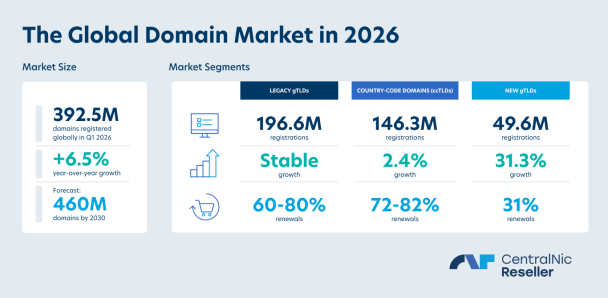
Before getting to individual extensions, it helps to see the shape of the whole market. Verisign’s Domain Name Industry Brief shared that 392.5 million domains were registered worldwide at the end of the first quarter of 2026. That figure has been climbing steadily, and the Global Industry Analysts forecast puts it on track to reach around 459.9 million by 2030. Steady, dependable growth.

Most of that growth is in one place. You see, the market splits into three broad categories, and they are not behaving the same way.

Category Registrations
(Q1 2026)
Year-over-year
growth
Typical
renewal rate

Legacy gTLDs (.COM, .NET, .ORG and others)

196.6 million Low single digits 68% to 80%

Country-code TLDs (ccTLDs)

146.3 million 2.4% High, often 75% to 82%

New gTLDs (.XYZ, .SHOP, .ONLINE and others)

49.6 million 31.3% Low, around 31%

As you can see, new gTLDs are expanding more than ten times faster than the legacy category, but their combined renewal rate sits at a mere 31%. Country-code extensions grow more slowly, yet they renew like clockwork, with the strongest holding above 80%. Finally, the legacy extensions are barely growing but anchor the whole market through their stability.

Every successful reseller knows that while volume looks good on a dashboard, it’s renewals which pay the bills. The best TLDs for resellers are the ones that deliver both, and a smart portfolio mixes high-growth extensions that win new customers with high-retention extensions that keep them.

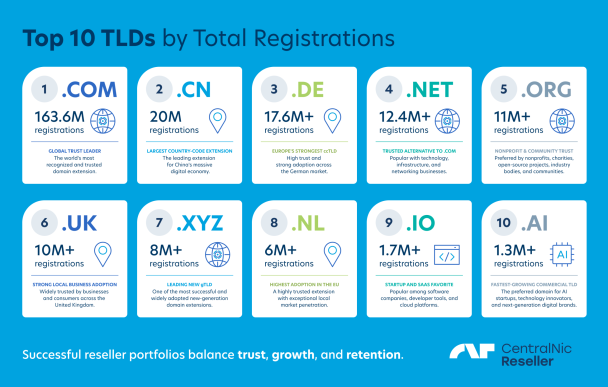
Finally, here’s the list you’ve been waiting for, starting from .COM and running through the most popular domain extensions after it, with the numbers (based on Verisign’s data) and the reasoning behind each.

.COM: The Global Benchmark for Trust and Recognition

With 163.6 million registrations, .COM remains the most popular domain extension on earth by a margin nobody else is close to. It is the extension people type from memory, the one customers trust without thinking, and the one every new business still checks first. Three decades of habit are not undone quickly, even as the share of the wider market slowly shifts.

For resellers, .COM is the dependable core of any inventory. Renewal sits at a healthy 76% across the combined .COM and .NET base, demand is utterly stable, and pricing power is strong because customers will pay to protect a name they consider their primary identity. Unfortunately, good .COM names went years ago, which is exactly why the rest of this list exists. Sell the .COM when it is available, and have a strong second option ready for when it is not.

.CN: The World’s Largest Country-Code Domain

China’s .CN is the largest country-code extension in the world, with roughly 20 million registrations. And while that’s eight times smaller than .COM, it’s still a deal. It is the front door to the biggest single national internet market, and demand is driven almost entirely by local business need rather than international speculation.

For resellers serving customers who trade into China, or Chinese businesses building a domestic presence, .CN is basically essential. Registration requires meeting local verification rules, which raises the barrier slightly, but that same barrier keeps the namespace cleaner and the registrations more committed. This is a specialist extension with a very large audience.

.DE: Europe’s Strongest Country-Code Extension

Germany’s .DE is the largest ccTLD in Europe and one of the largest in the world, at around 17.6 million registrations. It reflects a simple truth about German business culture: a German company is expected to have a German domain. Trust, locality and a certain seriousness all travel with the extension.

That cultural expectation makes .DE a high-retention, low-drama extension for resellers. German businesses register their .DE and keep it, year after year, because operating without one looks unprofessional to German customers. For any reseller with a European footprint, .DE is one of the safest portfolio additions available.

.NET: The Established Alternative to .COM

.NET has been the reliable second choice for as long as .COM has been the first. With 12.4 million registrations and the highest renewal rate of any extension in the top ten, around 80%, it carries the sort of respect that only time can give. Technology firms, infrastructure providers and networks have always gravitated to it.

For resellers, .NET is the natural upsell when a customer’s preferred .COM is taken. It is familiar, it is trusted, and it does not require any explanation. Plus, of course, the renewal rate is great. It will never be the fastest-growing line in your catalog, but it is one of the steadiest.

.ORG: Trust, Credibility, and Mission-Driven Branding

.ORG occupies a niche no marketing budget can buy: it signals purpose. It’s designed for nonprofits, charities, open-source projects, industry bodies and community groups, and tells visitors what sort of organizations they are. It remains one of the largest legacy extensions, with roughly 11 million registrations, and it renews at around 77%.

That’s a great number. Organizations that register a .ORG tend to be institutions, and institutions renew. They rarely churn, they often hold the name for decades, and they value the credibility enough to pay for it. If you serve the nonprofit, education or association sectors, .ORG is among the best domain extensions for resale value precisely because the customers behind it do not leave.

.UK: A Mature Market with Strong Local Demand

The United Kingdom’s .UK is a mature, well-governed extension with around 10 million registrations and a renewal rate that sits around 79%, one of the strongest of any major TLD. British businesses use it as their default, particularly as it’s locally trusted.

This is another domain of these tops where the renewal rate is key. Nearly four out of five .UK domains come back each year, which is why they keep growing, both in the world and in your inventory. It is a textbook example of a high-retention extension that quietly compounds revenue.

.XYZ: The New Generation Global Domain

With 12 years’ hindsight, it’s clear that .XYZ is the breakout new gTLD, now ranking among the ten largest extensions of any kind worldwide, with a total of 8.1 million domains registered. It’s a category neutral namespace that works for anything, which is both its strength and the source of its main weakness: renewals.

Like most new gTLDs, .XYZ wins enormous volumes of first-year registrations, often driven by promotional pricing, but a large share do not renew. For resellers, this makes .XYZ a powerful acquisition tool. It brings price-sensitive customers through the door at low cost, and the job then becomes converting them onto something stickier. Used that way, with eyes open about the churn, it is a genuinely useful domain to sell.

.NL: One of Europe’s Highest-Performing ccTLDs

The Netherlands punches far above its size online. With around 6 million registrations for a country of 18 million people, .NL has one of the highest per-capita adoption rates anywhere, and it sits comfortably in the global top ten ccTLDs. Dutch businesses and individuals treat a .NL as the obvious choice, and its ability to splash into Benelux markets is always useful.

.IO: The Preferred Extension for Startups and SaaS Brands

.IO built its reputation as the default for startups, developer tools and SaaS brands, and it still carries that association strongly with about 1.76 registrations in 2026. The short, technical feel of the name made it a status signal in tech circles, and pricing power followed.

There is, however, a potential worry over the domain. You see, .IO is the country code for the British Indian Ocean Territory, and a 2025 sovereignty agreement between the UK and Mauritius has raised questions about the extension’s long-term status. It is likely to be fine, but it’s not 100% certain. For resellers, .IO remains a strong seller into the startup market with healthy margins, but it is worth being honest with customers about the governance question rather than pretending it does not exist.

.AI: The Fastest-Growing Commercial Domain Extension

No extension better captures the moment than .AI. Officially the country code for Anguilla, a Caribbean island of about 15,000 people, it crossed one million registrations in January 2026 after years of explosive growth tied to the artificial intelligence boom. Renewal rates run around 90%, which for a relatively young commercial extension is remarkable.

It’s a fantastic success story. AI startups treat a .AI the way an earlier generation treated .COM, and they pay accordingly. The extension has become so valuable that .AI fees are now a significant chunk of Anguilla’s national budget. For resellers, .AI combines the two things that rarely appear together: rapid growth and high retention. It is one of the strongest branded domain extensions for businesses on the market, and demand shows no sign of cooling.

Fastest-Growing Domain Extensions in 2026

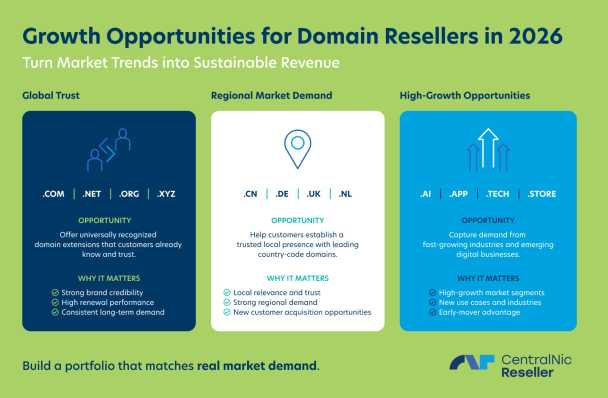
Beyond the established names, a cluster of newer extensions is growing faster than almost anything else. The new gTLD category as a whole expanded 31.3% year over year. These five are among the most commercially relevant for resellers building toward 2030

.TECH

The .TECH domain has become the natural home for technology companies, electronics brands and anyone wanting an unambiguous signal about what they do. What makes it interesting is that .TECH is a premium domain, with a premium price point, which tells you that demand is sometimes not just for cheap names but for valuable ones. And the best thing about premium domains is that your added services look like easy-to-add bargains next to their price.

.ONLINE

.ONLINE is one of the largest new gTLDs in the world and sits inside Verisign’s top ten generic extensions. It’s a straightforward domain that says “yes, we’re online” without narrowing the scope of potential targets, allowing strong, steady registration volume. That breadth of appeal is what’s great for resellers: almost any customer can find a use for a .ONLINE, which makes it an easy cross-sell from other domains.

.STORE

This domain does one job and does it perfectly: it tells visitors they have arrived somewhere they can buy something. With ecommerce still expanding worldwide, the extension has earned a place in the top ten generic TLDs. For resellers serving retailers, dropshippers and direct-to-consumer brands, .STORE is a clean, intuitive option that customers grasp instantly. It sells itself.

.CLOUD

While .CLOUD is the smallest domain on this list, with just shy of 600,000 registrations, it has ridden the same growth wave as enterprise IT itself. Hosting providers, SaaS firms and infrastructure businesses use it to show exactly where they operate, and adoption has been strong and durable. For resellers with a customer base of MSPs, hosting companies and IT service providers, .CLOUD aligns neatly with what those customers already sell, which makes it one of the more natural portfolio additions for the B2B technology market.

.APP

This Google registry domain continues the pattern of the other four fastest growing domains: having an obvious link to the internet economy. On top of that, every .APP domain requires HTTPS at the browser level, which makes it the obvious choice for software publishers and mobile developers who need to project trust. Together, that has pushed it past the 1 million mark for registrations. For resellers, it pairs well with developer-focused customers who already understand why it matters.

What Types of New TLDs Could Enter the Market

The biggest structural change in years is already underway: ICANN’s new application round for entirely new top-level domains opened in April 2026 and runs through the summer, the first such round since 2012. That earlier round produced more than 1,200 new extensions and changed what we expected from domain extensions. This one could do the same.

We’re expecting two main trends. The first is internationalized domain names, with new extensions expected across more than 300 languages and scripts. For the first time at scale, businesses in non-Latin markets will be able to register names entirely in their own writing systems, which opens genuinely new regional demand. The second is the continued arrival of brand and industry extensions, as large companies and sectors apply for namespaces of their own.

For resellers, the best bet is to watch the round closely and prepare. The extensions that emerge over the following years will create fresh inventory, fresh demand and fresh upsell opportunities, particularly in regional markets that have been underserved until now. If you understand the what’s and why’s of these new domains early, and can offer them early to a market that actually wants them, you could strike domain gold.

Prepare for what’s next.

New TLDs create new opportunities. Partner with CentralNic Reseller to access new gTLD launches, expand your domain offering, and grow your business with the platform and support you need to succeed.

Become a Reseller

Knowing which extensions are popular is one thing. Turning that into revenue is another. But there are some guiding principles that can help you make your bottom line.

The first and obvious one is: sell what the market wants. The data above is, in effect, a shortlist of the best domain extensions for a portfolio, and a buying list. Stock the global anchors, the regional leaders relevant to your customers, and a considered selection of high-growth niche extensions. You want your offerings to mirror real demand.

Conversion improves when the right extension is available at the moment of need. A customer searching for a name who finds their preferred .COM gone will often abandon the purchase entirely, unless a strong alternative is right there. Offering .NET, a relevant ccTLD or a fitting new gTLD in the same breath turns a dead end into a sale. Having those options when reselling is, quite simply, a conversion tool.

We say it a lot, but don’t forget that retention is where real, consistent money lives. A customer on a high-renewal extension like .UK, .DE or .AI is worth far more over time than one on a 14% renewal new gTLD, even if both cost the same to acquire. Guide customers toward extensions that fit their long-term needs, and your long-term profit.

Then there is the upsell. Premium and high-growth extensions like .TECH and .AI often have buyers who are much less price sensitive, which means you have the opportunity to offer more products than just the domain. You can offer selections of defensive registrations across other extensions to protect the customer’s brand, as well as backend products like premium SSL or DNS. And when a customer has more products with you, you haven’t just improved how much they’re earning, you’re making it less likely they leave.

Finally, the aftermarket adds another layer for resellers willing to engage with it. Demand for authority domains and keyword-rich names continues to climb, and the secondary market has matured into a serious asset class. Resellers who understand domain appraisal factors, watch expiring domain auctions, and help customers think about resale value as well as utility can open an entirely additional revenue stream alongside fresh registrations.

How CentralNic Reseller Helps Partners to Grow

Strategies like these only work if the platform behind it can deliver. That is the role CentralNic Reseller plays for thousands of partners worldwide.

Access to a broad global portfolio of TLDs is the starting point. We give resellers a single point of access to the legacy extensions, the major country-code domains, niche and emerging gTLDs than anyone else, so you can stock the names your customers want without negotiating with dozens of registries yourself. Every TLD in this guide is available right here, through a single account.

Regional and high-growth extensions are a particular strength. Demand in 2026 is increasingly local and increasingly specialized, and we maintain deep coverage of the ccTLDs and niche extensions that let resellers serve specific markets properly. Whether your customers need a .DE in Germany, a .NL in the Netherlands or a .AI for an AI adventure, the inventory is there.

Automation and scalability matter once the portfolio grows. Our platform is built for resellers who are scaling, with bulk management, API tools designed to handle almost everything, as well as plug-ins for popular backends like WHMCS. Because growth should not mean drowning in administration, and our infrastructure is designed so it does not.

Most of all, we help partners capture new revenue opportunities and prepare for the market of 2030. As the ICANN round brings new extensions, as regional demand deepens, and as the balance keeps shifting beyond .COM, the resellers who move early will take the share. We exist to make moving early straightforward, so our partners can focus on selling rather than on plumbing.

The domain market is no longer a single-extension affair, and it hasn’t been for a while. That is great news for resellers. More popular domain extensions means more ways to win a customer, more ways to keep them, and more ways to grow what each one is worth. Build the diversified portfolio the market is asking for, and let us handle the platform underneath it.

Join CentralNic Reseller Today

FAQ

.COM remains the clear leader at 163.6 million registrations, followed by major country-code extensions like .CN, .DE, .UK and .NL, established generics such as .NET and .ORG, and fast-rising commercial extensions including .AI, .IO and .XYZ. The defining feature of 2026 is breadth: popularity is now spread across far more extensions than it was a decade ago.

Yes. ccTLDs grew 2.4% year over year to 146.3 million registrations, and the strongest of them renew above 80%, among the best retention rates of any extension type. As businesses prioritize local trust and regional relevance, country-code extensions like .DE, .UK and .NL are an increasingly important part of a balanced portfolio.

What are new gTLDs and why are they important?

New gTLDs are the generation of generic extensions introduced from 2014 onward, such as .XYZ, .ONLINE, .STORE and .TECH. They are important because they are the fastest-growing category in the market, up 31.3% year over year, and they give businesses descriptive, available alternatives when legacy extensions are taken. The trade-off is lower renewal rates, so they work best as acquisition and upsell tools.

Are new gTLDs considered best domain extensions for startups?

For many startups, yes. Extensions like .IO, .APP and .TECH have become natural homes for technology ventures, telling the customer exactly what a company does. The main consideration is long-term cost and stability, which is where guidance from a knowledgeable reseller adds real value.

The extension is part of the brand. A trusted extension like .COM, .ORG or a relevant ccTLD reassures visitors and lifts conversion, while a poorly matched extension can create hesitation. Choosing an extension that fits the audience and the purpose directly affects how credible a business looks and how readily customers act.

Because the two do different jobs. Popular legacy and country-code extensions deliver trust and high renewals, while niche and new gTLDs drive growth and acquisition. A diversified portfolio captures both, which produces better conversion, stronger retention and more resilient revenue than relying on any single extension.

Start with demand. Stock the global anchors like .COM and .NET, add the country-code extensions relevant to your customer base, and include a considered selection of high-growth extensions like .AI, .TECH and .ONLINE. Weigh renewal rates alongside registration volume, since retention is what makes a portfolio profitable over time.

.COM will almost certainly remain the largest, but its share will keep shrinking relative to the rest, continuing a slide that has been running for over a decade. Expect continued strength from major ccTLDs, sustained growth from commercial new gTLDs like .AI and .TECH, and an entirely new wave of extensions, including internationalized names, emerging from the 2026 ICANN round.

What role does CentralNic Reseller play in accessing the best domain extensions?

CentralNic Reseller gives partners single-point access to a broad global portfolio spanning legacy, country-code and new gTLD extensions, together with the automation and scalability needed to manage them at volume. That lets resellers stock exactly the mix their customers want, serve regional and high-growth markets properly, and position themselves for the opportunities the next five years will bring.

You may also like