
2026 is going to be a big year for the domain reselling industry, kicking off seismic shifts that’ll affect how everyone does business and what types of domains we sell. In this article, we dive deep into what is going to cause that, and what that’ll mean for resellers.
Blog
Andrew Moore
Digital Marketing Writer, Domain Industry
Digital Marketing Writer, Domain Industry
Domain Name Market Trends 2026: Insights for Resellers
The Domain Reselling Landscape in 2026
Believe it or not, a 16,000-person Caribbean island is now earning more from domain registrations than from most of its visible economy combined. Anguilla’s .AI extension crossed a million live domains in January 2026, contributing somewhere around USD 93 million to government revenue last year. That is roughly twenty-two percent of the island’s entire budget, paid in renewal fees by AI startups in San Francisco who needed a two-letter ccTLD that happened to spell their industry.
It is a strange story. It is also a useful one, because it is the cleanest illustration we have of how trending domain names are part of the future in 2026. Not the boring version where everyone races to the bottom on .COM pricing. The interesting one, where the right two letters at the right time can rebuild a country’s tax base.
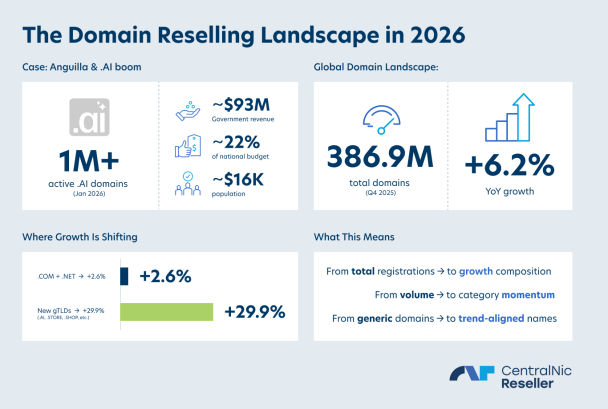
Most coverage of domain name trends still leads with topline registration counts. Verisign’s Q4 2025 Domain Name Industry Brief puts that number at 386.9 million, up 6.2 percent year on year. Which is good, but also misses the point. Underneath the topline, the composition of growth has shifted. Where .COM and .NET combined grew 2.6 percent, newer gTLDs (.AI, .STORE, .SHOP and the rest) grew 29.9 percent. If you sell domains for a living, those newer spaces need your attention.
Why Domain Market Trends Are Shaping Reseller Strategy in 2026
For a long time, the reseller business worked on a simple equation. Buy domains wholesale, sell them with a markup, push enough volume through the pipe, and the margin took care of itself. The product was effectively a commodity. You competed through logistics, not through strategic positioning.
That equation is starting to fall apart. You see, three things are happening at once. ICANN raised its registrar fee in July 2025, the first increase in over a decade, and a follow-on transaction fee adjustment is built into the new contracts. New gTLD launches are accelerating, with the 2026 application round opening at the end of April and likely adding hundreds of new extensions over the next two to three years. Finally, buyer behaviour has split: on one side, .COM renewal rates remain in the 70% ranges, while on the other, some new gTLDs are renewing in the low teens.
Put plainly, the cost floor is rising while the renewal curve under newer products is getting steeper. Volume alone does not absorb that. Strategy does. The resellers who outperform in 2026 will be the ones who treat their TLD mix like a product portfolio, treat renewals as the actual revenue, and treat infrastructure as the difference between a healthy cost-of-living and a slow leak. If you’re looking for your big domain name market trends, those are them.
Domain Name Industry Trends in 2026 That Resellers Cannot Afford to Ignore
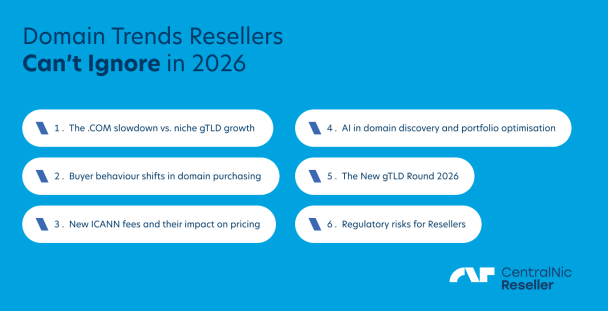
So, what are some of the key domain trends that are looking to shape to industry in 2026 and beyond? We’ve got six things you should be thinking about as plan for the future of your reseller business.
The .COM slowdown vs. niche gTLD growth
The two-track market is the trend that frames every other insight. Verisign’s Q4 2025 numbers show legacy gTLDs growing slowly, ccTLDs holding steady at around 142.9 million registrations, and newer gTLDs jumping nearly 30% year on year. New gTLDs are now 12.4% of all registrations and rising. Notably, .XYZ and .TOP both stepped into the top 10 most registered domains.
What this means for resellers is not “drop .COM.” No, .COM is still the default, still the most renewed, still the easy sell. But the growth conversations, the ones that move ARPU rather than just topline registrations, are happening at the niche end. And while .AI dominates the headlines, others like .STORE, .XYZ and the geo-extensions are all part of that growth.
Buyer behaviour shifts in domain purchasing
Buyers are doing two things they did not do five years ago. They are buying multiple domains per project: a primary, a redirect, a defensive, sometimes a TLD-variant for a different market. And they are expecting the domain to arrive bundled with hosting, email, SSL, and DNS already pointed somewhere sensible. The standalone domain purchase is becoming a power-user behaviour.
The InterNetX/Sedo Global Domain Report 2026 puts AI-related buying behaviour at the centre of this shift. Sixty-six percent of industry respondents said AI affected sourcing or sales in 2025, with 40% pointing to LLM’s like ChatGPT or Claude’s impact on name generation specifically. The buyer journey now starts with a model spitting out fifty plausible names. The buyer narrows to five, checks availability across several extensions, and buys two or three. That is a something you can either monetise or lose to the platforms that do.
New ICANN fees and their impact on pricing
This one is straightforward. The ICANN per-domain fee moved for the first time in a decade in mid-2025, from USD 0.18 to USD 0.20. Two cents. It does not sound like a lot until you multiply it across an entire domain reseller portfolio, and combine it with the registrar accreditation fee adjustment that landed at the same time.
The pricing question for resellers is whether to absorb, pass on, or rebundle the cost. Absorbing it eats into your margin. Passing the cost on annoys customers. Which leaves rebundling – folding the increase into a larger, more useful product – as the only way to protect the customer relationship. But rebundling requires a platform that can package those products together cleanly. We’ll get back to this.
AI in domain discovery and portfolio optimisation
Naming is the big “human creative task” that LLMs turned out to be alarmingly good at. Using these tools, it is no longer difficult to quickly get suggestions for brandable, trending domain names, score them against trademark databases, and check availability across thirty extensions. And this is usually done in one query, making it the first step in any domain purchasing journey.
This affects resellers in two ways. First, buyers arrive better informed, with shortlists already in hand, which compresses the upsell window. But those AIs can also make portfolio management simpler on the seller side. Things like automated valuation, expiry-prediction, renewal-likelihood scoring, fraud detection have moved from custom data-science projects in 2022 to commodity features in 2026.
The new gTLD round 2026: market expansion opportunities
ICANN’s second round of new gTLD applications opens on 30 April 2026 and runs through 12 August. The first new TLDs from this round will likely launch in late 2027 or early 2028. Estimates of how many will apply vary wildly, somewhere between 600 and 1,500 depending on which consultancy is doing the projecting, but everyone agrees there will be more brand TLDs, more geo TLDs, and more niche industry extensions than the 2012 round produced.
For resellers, this is an opportunity in waiting. Working out which new gTLDs fit your offering, whether your market can both afford them and will renew them, and, of course, if your current platform offers them, is something you’ll have to investigate over the next two to three years. You can’t just chase the trending domain names after they’ve released, as not only will you have already missed the biggest money, they likely won’t fit your brand or strategy.
Regulatory Risks for Resellers
NIS2 is the domain name industry trend that just does not get enough attention. The EU directive expands cybersecurity obligations to a much wider set of organisations, and has made registries and registrars part of the process for getting accurate registration data and abuse handling. At same time ICANN is making a push on DNS abuse compliance.
The practical consequence for resellers is that you can’t just say “that’s the registrar’s problem” anymore. Abuse reports, takedown obligations, and registration data accuracy expectations now flow downhill. Either you choose a registrar partner that does the heavy lifting on compliance, or you build that capability yourself. Spoilers: the first option is cheaper.
Changing Buyer Behaviour and Domain Lifecycle Economics
Domain buyers are price-sensitive at year one and astonishingly price-insensitive at year three. Which means year-one pricing wins the click, but renewal pricing pays the bills. The fact that these two prices are usually different on the same product is the central oddity of the domain industry, and it is responsible for most of the bad reseller economics we see.
When looking at this, Verisign’s renewal data is the single most useful chart in the industry. It shows quarter-on-quarter renewal rates, by category, in late 2025, roughly as follows: .ORG renewed at 86.2 percent, .COM and .NET combined renewed at 75.3 percent, legacy gTLDs averaged 82.5 percent. While at the same time new gTLDs averaged 32.2 percent. .SHOP was the lowest of the major new gTLDs, renewing at 12.2 percent.
Take a moment with that last number. For every hundred .SHOP domains a reseller sells in year one, twelve are still around in year two.
This is the volume-versus-strategy argument made in a single statistic. A reseller who sells a hundred .SHOP domains and a reseller who sells a hundred .ORG domains are running entirely different businesses, even if their year-one revenue looks similar. The .ORG reseller has eighty-six recurring customers next year. The other has twelve.
Unfortunately, as growth numbers have shown, those legacy TLDs’ growth has plateaued, while the new gTLDs is shooting up. So, sticking to the renewal-resilient end of the market only really works if you’ve already got that customer base. If you’re looking to make good use of these trending domain extensions, you’ll need to look at strategies around price and bundling to lift renewal rates. Or reframe new gTLDs as a customer acquisition tool where the renewal is the bonus, not the assumption.
Speaking of which, one of the key domain trends for resellers is that standalone purchases are giving way to bundles. Email hosting, SSL, DNS management, basic site builders, privacy registration, and increasingly productivity suites are all bundled into the cart at checkout. The bundle does three useful things. It lifts average revenue per user (ARPU). It creates more dependencies, which makes it harder for a customer to move, and so improves renewal rates. And it makes the price comparison harder, which protects margin.
Of course, this only works if the bundle is technically simple. Provisioning a domain with email and DNS pre-configured is straightforward; but provisioning it badly, with manual stitching between four different vendors, will see support tickets and time eat into your margin.
On the plus side, single-domain customers are becoming rarer. The new domain trend is a small portfolio per project: primary, redirect, defensive, and country-variant. Brand-protection thinking has moved downmarket. Small e-commerce operators now register the .SHOP and the .STORE and the country ccTLD for their primary market. This is being driven by AI naming tools, which supply all the brandable variants in the same query.
This is great for resellers. Whether they buy one domain or six, individual customers have similar acquisition costs, but the latter has six renewals and a stronger reason to consolidate the rest of their stack with you.
Finally, buyers now expect a domain to work the moment they pay. Not next morning when DNS finally propagates. Not after a support ticket. Now. Anyone who lived through manual EPP transfers a decade ago can tell you this is a real change.
Instant provisioning is an infrastructure problem dressed as a customer experience problem. APIs that return synchronously, registry connections that are healthy, DNS templates that apply automatically: those three things are the difference between a customer who buys again and a customer who writes an angry tweet. And while you can’t control most of that as a Reseller, you do choose your reseller platform, who does.
TLD Market Dynamics: Where the Real Growth Opportunities Are
Generic TLDs remain the heart of the market. Legacy gTLDs sit at roughly 194 million registrations with slow growth. While new gTLDs from the 2012 round add another 48 million, with fast growth in parts (and not at all in others). The interesting strategic question is which of the trending domain extensions are durable. .AU, .IO, .APP, and a handful of vertical extensions have crossed into general acceptance. Many others have not, and probably will not.
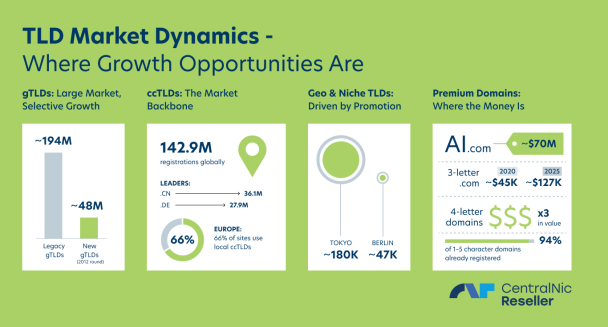
ccTLDs are the quiet workhorses, having around 142.9 million registrations globally, with .CN (36.1M) and .DE (27.9M) leading. In Europe, roughly 66 percent of websites use a local ccTLD over a generic alternative. They renew well, they are trusted by local buyers, and the only reason to under-stock them is that registry-by-registry connectivity is operationally annoying. Which, again, is a platform problem.
Geo TLDs sit between gTLDs and ccTLDs. Numbers are modest. .TOKYO is around 180,000 and .BERLIN around 47,000. Adoption is durable in cities that have actively promoted their extension, and they reward local-market specialisation more than they reward bulk distribution. Niche and industry extensions (.LAW, .DESIGN, etc.) follow the same logic: well-promoted ones renew respectably, poorly-promoted ones do not, and the reseller’s job is to know which is which without taking the registry’s word for it.
The premium aftermarket is where the most visible money lives. The disclosed sale of AI.com for around USD 70 million was the big transaction of the last year. Three-letter .com averages have risen from roughly 45,000 in 2020 to USD 127,000 in 2025, while four letter names have tripled. Roughly 94 percent of one-to-five character domains are already registered. Trending domain names at the short end of the catalogue are now an asset class with real liquidity, and resellers who build aftermarket access into their offering capture a slice of a large fee pool.
Which TLD Portfolio Delivers Maximum ROI for Resellers in 2026
There is no universal portfolio. But our observations suggest that the answer lies in a certain amount of diversity.
You’ll want a defensive core of legacy gTLDs and the dominant ccTLDs in the markets you serve, making up over half of your catalogue. Remember, renewals are where the long-term money is, and these are the TLDs that are most likely to stay with you.
On top of that, you’ll want a targeted growth layer of new gTLDs focused on your niche. Try to choose based on evidence instead of hype, promote them aggressively, and adjust them quarterly on renewal performance. This could be around 20% of your portfolio.
If it makes sense, provide aftermarket access for the buyers who need it, even if it is just a curated lookup against your registrar’s premium feed. You’ll probably never use it, but if you do, it’ll be worth it.
In the end, the structure is less important than the principle: stock for renewals, not for catalogue size. Five hundred extensions you cannot service well are worse than fifty you can. In other words, you should pay attention to the trending domain names, but don’t chase them blindly, as the point is getting customers that stick around without wasting energy and resources on ones that don’t.
Revenue Growth Opportunities for Domain Resellers in 2026
The domain itself is the lowest-margin product that people are buying. Everything else attached to it (privacy, SSL, email, DNS management, basic site builders, productivity tools) has higher margin and stickier renewals. Yes, treating the domain as the loss leader for a richer cart is not new. But what is, is how good the bundling, automation, and cross-sell tools have become.
This is down to two tools: White-labelling, which makes sure a reseller gets to stand as their own business in the eyes of the consumer. Owning the brand, the storefront, and the support relationship is the difference between competing on price and competing on relationship.
The second is geographic expansion, one of the key domain name trends in 2026. Buyers in Brazil, Indonesia, or Nigeria expect payment methods that work locally. They don’t want to go through a US-Dollar checkout and will go to a competitor who lets them do business in their own currency.
Beneath both is the same thing: a platform that handles provisioning, billing, currency, and compliance cleanly enough to be invisible. You want the focus to be on your business, and your offering. Not the reseller platform’s.
The Future of Domain Names 2027–2030
It’s impossible to predict the future with 100% accuracy, especially as you project more years ahead. But there are some domain extension trends, whose impact is so real, that we think are worth considering.
AI-driven naming ecosystems
One domain name trend that will just be normal by 2030 is AI naming. Nearly every domain purchased through a reseller channel will probably have started with an AI-generated shortlist. The naming step that used to involve a brainstorm session, a thesaurus, and three rejected ideas now happens in a chat window in under a minute. Reseller storefronts that integrate naming assistance natively, alongside availability, pricing, and user-driven bundling, will do better than storefronts that treat it as a bolt-on.
Digital identity and multi-domain ownership
The trend toward small per-buyer portfolios will keep going. A typical small business in 2030 could own a primary .COM, a country ccTLD, possibly an industry niche extension, an email-only domain, and at least one defensive variant. That is five domains where there used to be one. Platforms need to make portfolio management feel like one product rather than five separate ones.
Blockchain domains and alternative naming systems
The honest read on Web3 domains in 2026 is that adoption has plateaued well below expectations. Combined registrations across ENS and Unstoppable sit around 10 million, mostly tied to wallet-as-identity use cases rather than general-purpose web addressing, while browser support remains spotty. The infrastructure is interesting and the use cases do seem real, but the actual market is smaller than hoped.
What you should do is watch but not chase. There may be a step-change moment when a large platform integrates blockchain domains natively, and adoption follows. But also, maybe not. It’s risky to bet on this future, but that doesn’t mean you should ignore it.
Brand protection in a multi-TLD world
The 2026 ICANN new gTLD round adds extensions to a market where defensive registration is already a real cost line for medium-sized brands. By 2030, a brand owner with mid-tier exposure could be paying for well over 50 defensive registrations across new gTLDs, ccTLDs, and geo TLDs. If you can position yourself for it, and provide brand protection services (monitoring, blocking, dispute support) you could end up in a differentiated space that renews well.
5 Strategic Takeaways for Domain Resellers
If you’ve read all that, and are now wondering what to do, don’t worry, we’ve got bite-sized moves you can make to answer the upcoming domain trends.
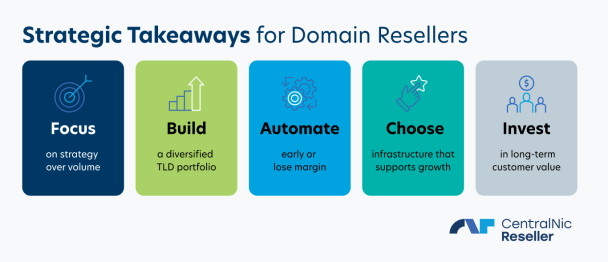
First, focus on strategy over volume. The reseller selling fewer domains to better customers will outperform the reseller selling more domains to worse ones. Renewal rates, customer lifetime value, and bundle attach are the metrics that matter.
Second, build a diversified TLD portfolio. A sticky legacy and ccTLD core, a curated and rigorously pruned new gTLD layer, geo TLDs where they fit, and aftermarket access for the buyers who need it. Catalogue size is not the goal. Renewal-weighted revenue is.
Third, automate early. Manual provisioning, manual renewals, and manual support are all margin-killers. By the time the rest of the market gets there, the early movers will already have a significant margin advantage.
Fourth, choose infrastructure that supports growth. The right platform is the one that disappears as you grow. The wrong one is the one that becomes the project.
Fifth, invest in long-term customer value. Acquisition is expensive, retention is cheap, and the whole arithmetic of the 2026 reseller business favours operators who treat the renewal as the real sale and the year-one purchase as the down payment.
Why CentralNic Reseller Is Your Competitive Advantage in 2026
Most of the strategic moves in this article are platform problems before they are strategy problems. Whatever the future of domain names looks like, you can have the right plan and still lose to operators with a better stack underneath them.
CentralNic Reseller is built for the operators who have decided to compete on strategy rather than on price. The platform offers:
- access to more than 1,900+ TLDs and SLDs,
- domain security services (such as DNS, SSL certificates and domain blocking solutions),
- full-featured APIs,
- white-label support,
- multi-currency billing,
- and the kind of automation that saves you time, effort and, ultimately, money.
And we are your partner in handling modern compliance regimes from ICANN and NIS2 and more, so you can focus getting more customers and more revenue.
Apply for the reseller programme and we will show you what your stack looks like with the right infrastructure behind it.
FAQ
How will domain market trends affect reseller margins in 2026?
The ICANN free rise, while small, is real, and will compress margins at the commodity end of the market. This, plus an ongoing consumer move towards multiple TLDs, should create opportunities for resellers to bundle domains and higher value services together.
Why is TLD diversification becoming more important for resellers?
Diversification is important because renewal rates vary by huge amounts depending on the TLD involved. For instance, .ORG renews around 86 percent quarterly, while some new gTLDs renew in the low teens. On the other hand, new gTLDs are seeing orders of magnitude more growth than the traditional ones. You want both the solid renewal base of classic gTLDs and ccTLDs and the potential to get new customers that new gTLDs offer.
How will new gTLD launches impact reseller growth?
The 2026 ICANN round is likely to add several hundred extensions over 2027 and 2028. The early phases of a launch are the highest-margin moments in the lifecycle, but only for resellers who plan launch marketing in advance, and are with a platform that plans to fully support them.
What trends are influencing domain renewal behaviour?
One of the big trends is that AI-assisted name generating has led to buyers are registering more domains portfolios rather than single domains (ccTLDs, defensive gTLDs, .etc) so renewal is increasingly a per-portfolio decision. At same time, bundled services are leading to higher renewal rates, as multiple products create customer stickiness.
What regulatory trends should resellers monitor in 2026?
The two main ones are NIS2 in the European Union, which is making data accuracy and abuse-handling both the registry, and the registrar and reseller’s obligation. And ICANN’s DNS abuse compliance work, which moved from advisory to enforcement-track in late 2025, and similarly makes compliance a reseller’s issue. Good platforms are working to make this obligation easier to handle.
How can resellers prepare for future domain market changes?
Make sure your reseller strategy is sound, focusing on the right TLDs for the market you serve and want to serve, with a long term revenue model that works. And then choose a platform partner whose products matches your goals, now and in the future.
You may also like
How CentralNic Reseller ACME Simplifies SSL Certificate Management Automation
October 8, 2026 | By Andrew Moore | 10 Min ReadAutomated SSL certificate management arrives on 5 October 2026.
Read more

How the .FLY TLD Creates New Opportunities for Domain Resellers
October 7, 2026 | By Andrew Moore | 21 Min ReadYou probably don’t think you need to an explainer about what the new .FLY domain is about, or why you would want to add them to your portfolio.
Read more
Why .DOT Domains Are the Next Big Opportunity for Domain Resellers
September 23, 2026 | By Andrew Moore | 17 Min ReadLet’s get the obvious out of the way first.
Read more